Just Me Travel

Just Me Travel

Solo Travel Blogger

Category: Africa

A WILDLIFE SAFARI ADVENTURE AT SANCTUARY STANLEY’S CAMP, OKAVANGO DELTA

Luxury Glamping Meets Unforgettable Wildlife Encounters in Botswana’s Okavango Delta: My Honest Sanctuary Stanley’s Camp Review.   Nestled in the heart of Botswana’s Okavango Delta, Sanctuary Stanley’s Camp offers an…

Luxury Glamping Meets Unforgettable Wildlife Encounters in Botswana’s Okavango Delta: My Honest Sanctuary Stanley’s Camp Review.


Nestled in the heart of Botswana’s Okavango Delta, Sanctuary Stanley’s Camp offers an exceptional safari experience where luxury and nature blend seamlessly. Glamping takes on a new meaning at this exclusive camp with spacious, beautifully appointed tents that provide the perfect blend of comfort and adventure. My time here was filled with exhilarating wildlife encounters during unforgettable game drives, where elephants, leopards, lions, giraffes, and other animals roamed freely. What truly sets Stanley’s Camp apart, though, is the personalised hospitality that made me feel like part of the family, ensuring an unforgettable stay in the African wilderness.

Join me as I unveil the charming appeal of this wilderness sanctuary and relive moments of wonder, awe, and connection with nature.


Sanctuary Retreats owns and operates luxury safari lodges and camps in Kenya, Botswana, Tanzania, Uganda, Zambia, and Namibia. Sanctuary Stanley’s Camp, named after the explorer Henry Stanley, is one of two Sanctuary Retreats’ camps in Botswana’s Okavango Delta.  It is in a large private concession on the southern tip of Chiefs Island and shares a border with the Moremi Game Reserve.

Stanley’s Camp is accessible by air. A flight from Maun takes about 15 minutes, and a flight from Kasane takes about 90 minutes. The camp itself is about a 20-minute drive from Sanctuary Stanley’s Camp’s private airstrip.

I flew to Maun in Botswana from Johannesburg in South Africa – a two-hour flight. For the first time in my extensive travels, check-in at Johannesburg Airport weighed my carry-on bag. Luckily, my two bags were under 20 kilograms when weighed together – the maximum limit for my light aircraft flights to and from Sanctuary Stanley’s Camp.

From Maun, I took a Mac Air flight to Stanley’s Camp. The plane was a six-seater – seven if you account for the pilot, and he probably should be included! The flight took ten minutes, and I had fantastic aerial views of the Okavango Delta.

Three of us got off the plane at Stanley’s Camp airstrip, which was simply hard, packed earth (like baked clay) but well maintained. At the airstrip, a Stanley’s Camp staff member met us in an open-sided 4X4 game drive vehicle. Before we could drive away, we had to wait for the plane to be airborne to ensure it took off okay.

About ten minutes from the airstrip, we stopped for a welcome ‘picnic’ in the bush, which included champagne, juice, soft drinks, and nibbles. I was grateful for the cold washer, and we were each given a water bottle with our name on it, which we were allowed to keep. These bush picnics would become a regular event over the next several days.

The advised 30-minute drive to the camp took 50 minutes, as we had to keep stopping to take photos of the elephants, giraffes, and wildebeest we encountered.

Arriving at the camp, the staff welcomed us with a song of greeting, a cold washer, and more drinks. In the meantime, the female staff (housekeeping) took our bags to our tents, carrying them on their heads. For my housekeeper, that was 12 kilos on her head! We had arrived at the camp in time for high tea (4.00 pm), which we had while checking in.

Check-in was more of a safety briefing:

  • We can walk around the camp on our own during the day but never at night.
  • Our guide must always escort us to and from our tent at night. Guests are allocated a group guide for the duration of their stay.
  • We must never use the pool at night.
  • Drink lots of water.

These safety precautions are necessary because wild animals – hyenas, monkeys, elephants, etc. – regularly enter the camp area.

After our safety briefing, a staff member showed me to my accommodation. The accommodation at Stanley’s Camp is glamping at its best. For those unfamiliar with the term ‘glamping’, it is a glamorous alternative to traditional camping. Stanley’s Camp has ten tents, all with views over the floodplains. ‘Tent’ does not adequately describe the accommodation. The tent is a luxurious, spacious room with a king-sized bed, an ensuite bathroom that doesn’t lack any facilities, and a large veranda with a daybed; it just has canvas for walls and roof. There’s no air conditioning, but the room has a ceiling fan and a standard misting fan, and the canvas walls roll up to allow the breeze to flow through.
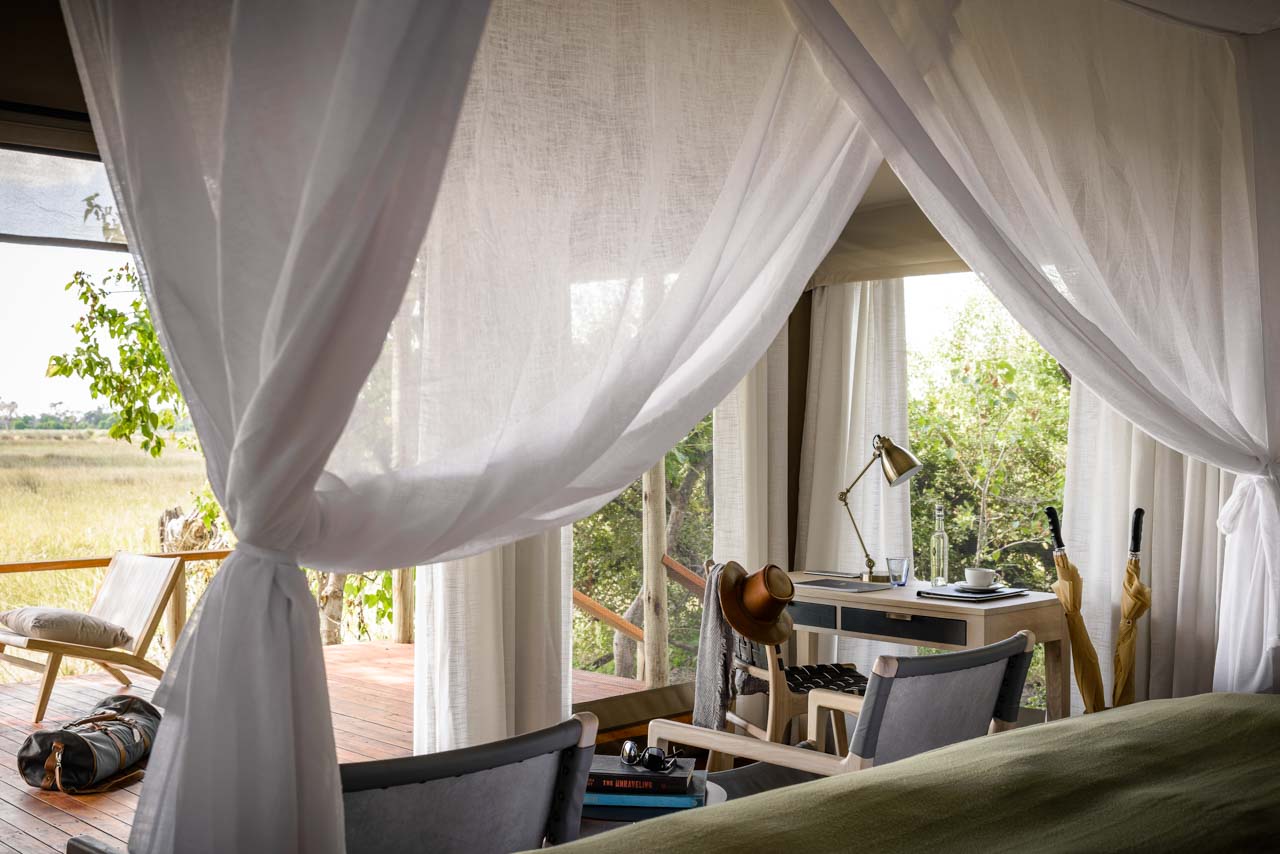
A tent is furnished with a bed, mosquito netting, chairs, and des. The tent has a chair and travel bag on the porch.

Glamping at Sanctuary Stanley’s Camp. (Courtesy of Sanctuary Retreats’ Trade Image Library)


My housekeeper pointed out the essential facilities in the room:

  • Insect spray (called Doom – appropriate name!),
  • personal mosquito spray (called Peaceful Sleep – I hope so!),
  • torch,
  • alarm horn (to scare intruding predators away),
  • emergency radio (walkie-talkie – hope I don’t need that!), and
  • WiFi is only available in our tents.

After settling into my tent, I met my guide for a mokoro safari through the waterways of the Okavango Delta. A mokoro is a traditional canoe that is propelled through the water by standing in the stern and pushing with a pole. While lazing in the mokoro was very relaxing, I was disappointed with this activity as I saw nothing but water lilies and reeds. I am not sure what I expected, but a few water buffalo or birds would have made the experience more interesting. I needed to remind myself that wildlife sightings are, to a great extent, unpredictable. However, on the drive to the mokoros, we came across a leopard sitting under a tree and spent some time taking photos before he left the shade of the tree, checking us out as he left the area.
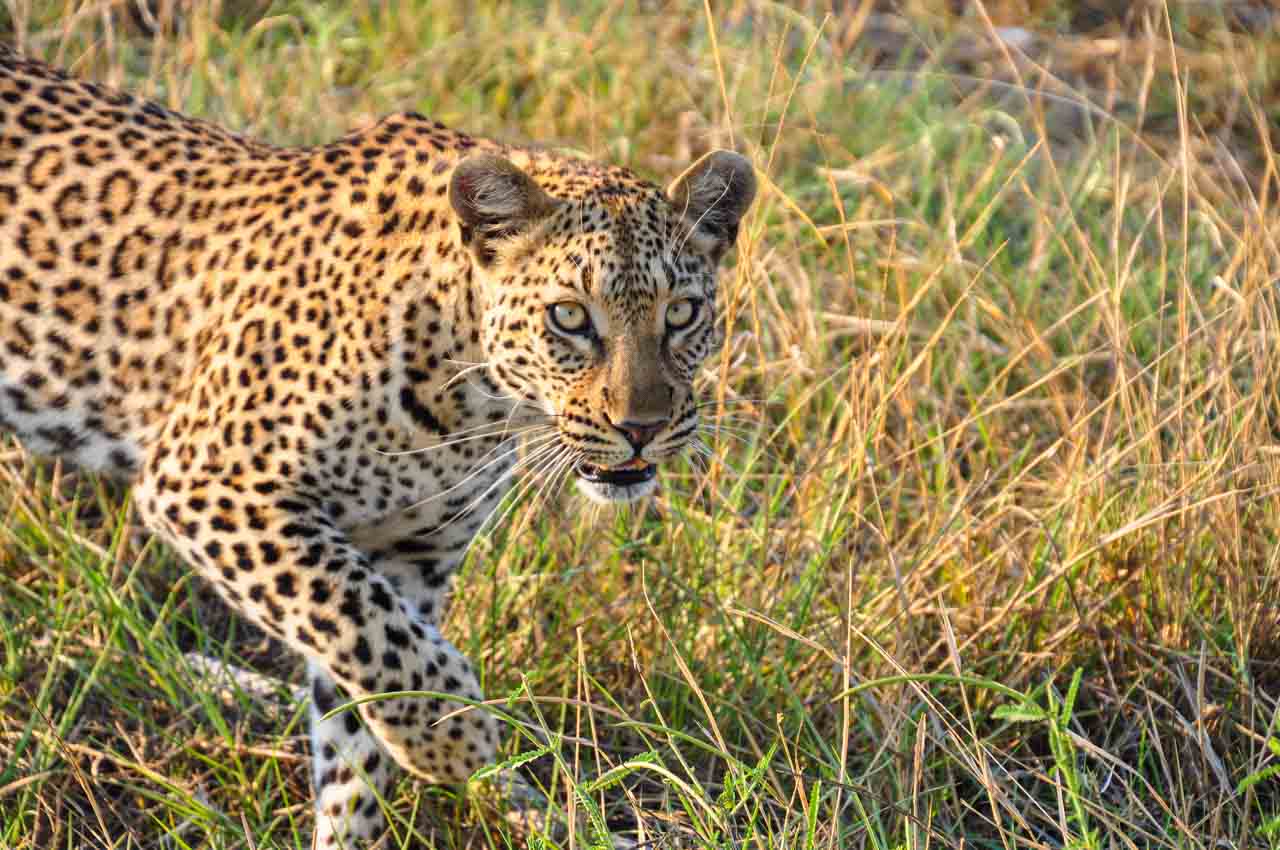
A leopard walks in the long grass as he faces the camera.

A leopard checks us out as he walks past our safari vehicle.


After the mokoro safari, drinks and nibbles were served in the bush by Stanley’s Camp staff before returning to camp.
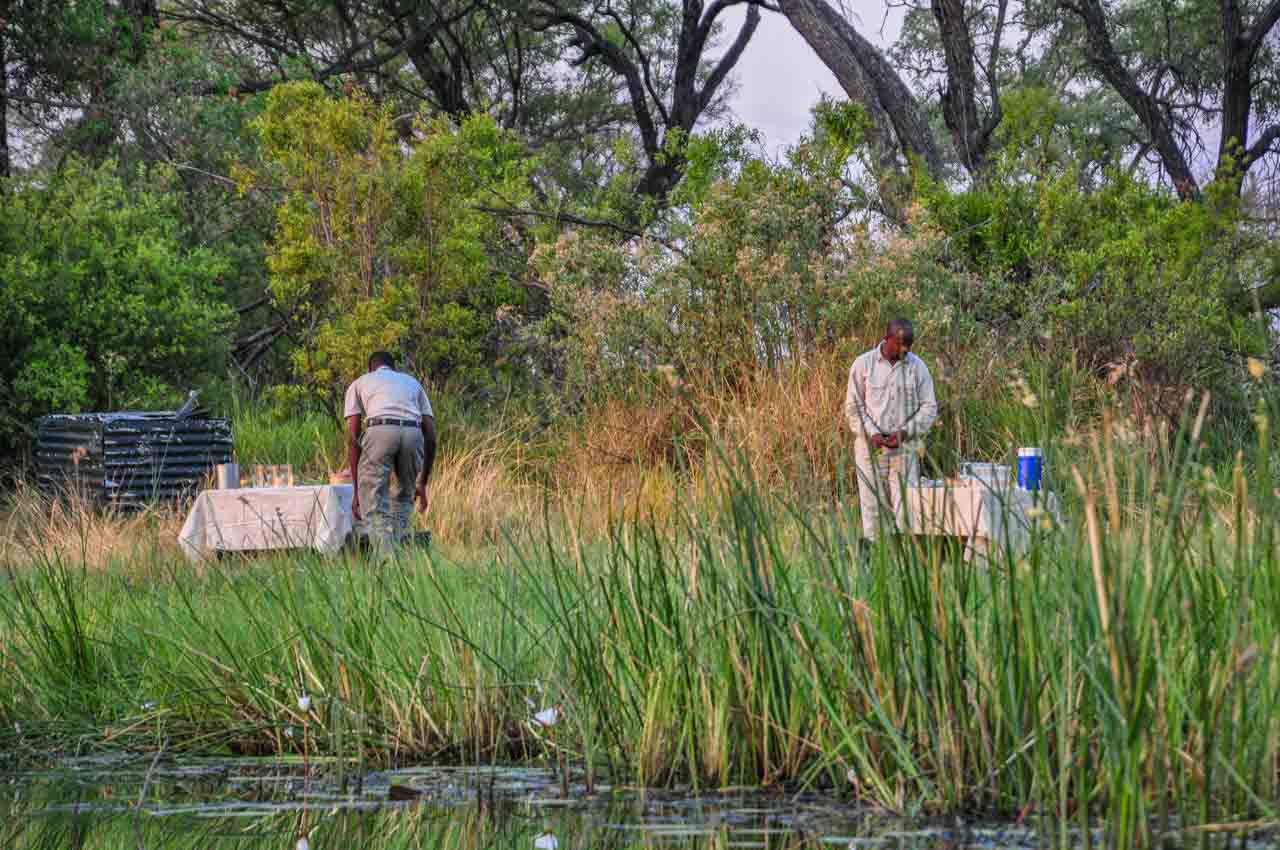
Two men prepare tables of food beside a waterhole with trees behind them.

Stanley’s Camp staff set up our mokoro safari ‘picnic’.


Back at camp, there were more drinks and the essential cold washer before being escorted to my tent to get ready for dinner.

Later that evening, my guide escorted me to the central tent for dinner. The food was excellent, as too was the coffee. During dinner, staff informed us that the plan for the following morning would be a wake-up call at 5.15 am, breakfast at 6.00 am, and leave for a game drive at 6.30 am. I questioned how staff managed a wake-up call given there was no phone in our tents – thinking the call might come via the emergency radio. One of the other guests informed me that a ‘wake-up call’ meant tea or coffee brought to your tent by staff. Now that’s civilised!

At dinner, I was given a handmade reed bracelet with my name woven into it. Such a nice gesture!

In addition to having all our meals in the central tent, it proved to be an idyllic place to socialise with the other camp guests.
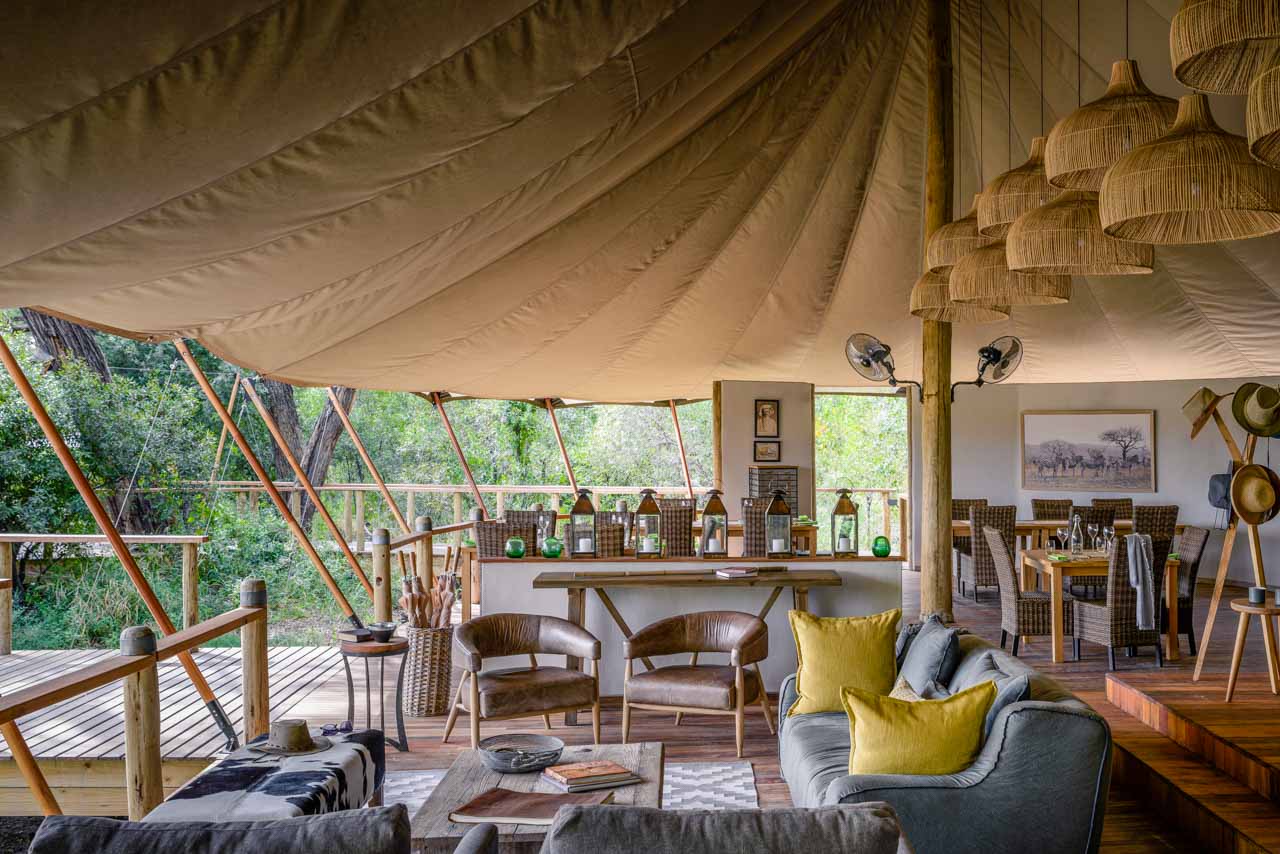
A tent is furnished with couches, chairs, a dining table and chairs, and a bar.

Stanley’s Camp central tent. (Courtesy of Sanctuary Retreats’ Trade Image Library)


I was sorely tested during my first night’s sleep, as I am sure I slept with every insect known to man. I sprayed myself in Peaceful Sleep and sprayed the bed in Doom, but it made no difference! And it was hot! I learned to encase my bed in the mosquito netting BEFORE leaving for the afternoon game drive.

On the morning of my first game drive, I was not only woken by my coffee wake-up call but also by several small monkeys making a racket in the trees outside my tent.

My Sanctuary Stanley’s Camp four-night package included accommodation, all meals, and game drives (morning and afternoon). I had come for the game drives, especially to see elephants and hippos, and I wasn’t disappointed. The excellent accommodation, delicious meals, and attentive staff hospitality were an added bonus – the icing on the cake!

On that first morning’s game drive, we saw so much wildlife. In the first hour, there were warthogs, buffalo, zebras, giraffes, impalas (easily distinguished from other antelope because of the black stripes on their rear end), and one lone bull elephant. There was no more wildlife for the next three-quarters of an hour, and I thought that was it. Then we came across a couple of saddle-billed storks, soon followed by a group of elephants. More wildlife quickly followed: different types of antelopes, four or five herds of elephants, a large flock of stocks fishing in a pool of water (different to those seen earlier), baboons, more warthogs, lots more buffalo, and cross it off my bucket list, a pod of hippos in a waterhole. The zebras had several foals in the herd, while the elephant herds had elephants of differing sizes (ages).
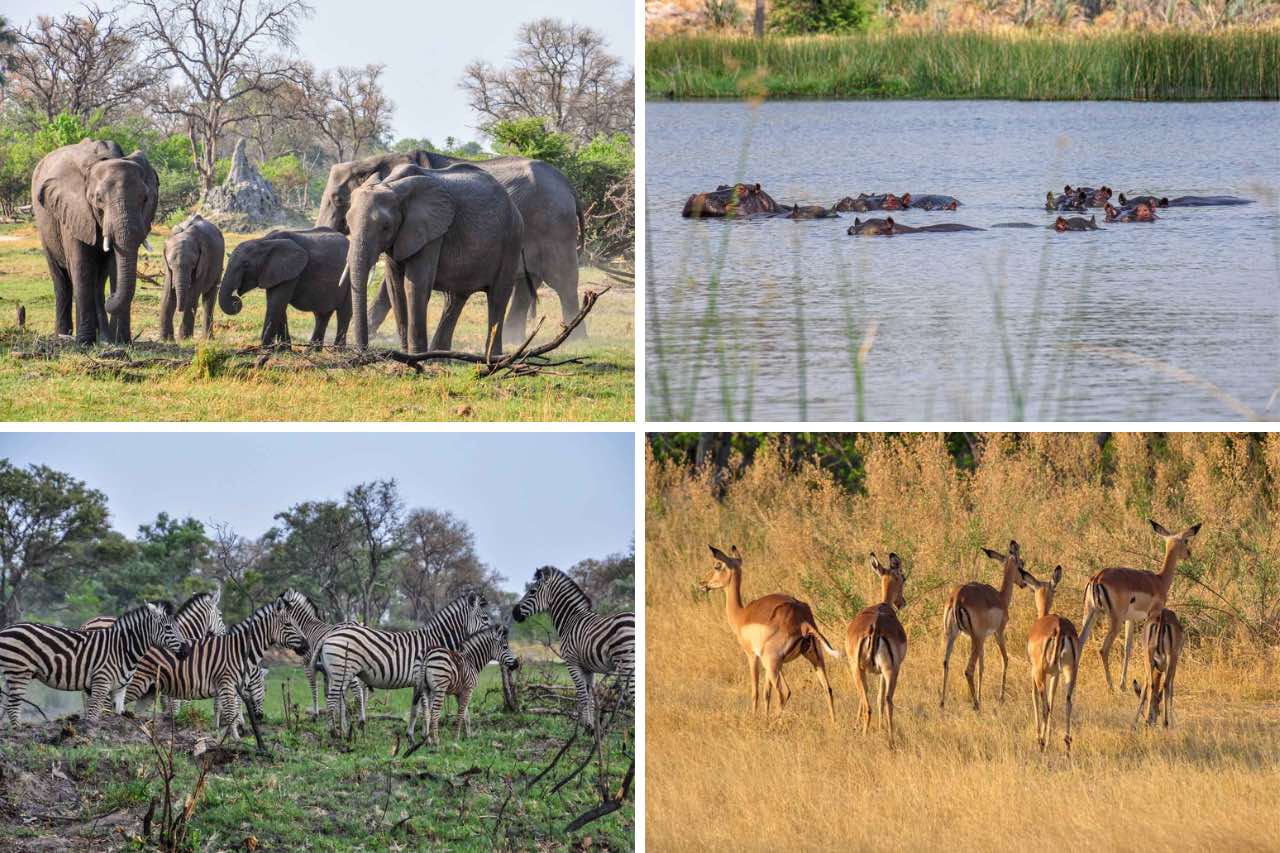
An image with four photos of African wildlife - a herd of elephants, hippos in the water with just their eyes visible, a herd of zebras, and impalas with their backs to the camera.

Wildlife seen on the morning game drive – elephants, hippos, zebras, and impala.
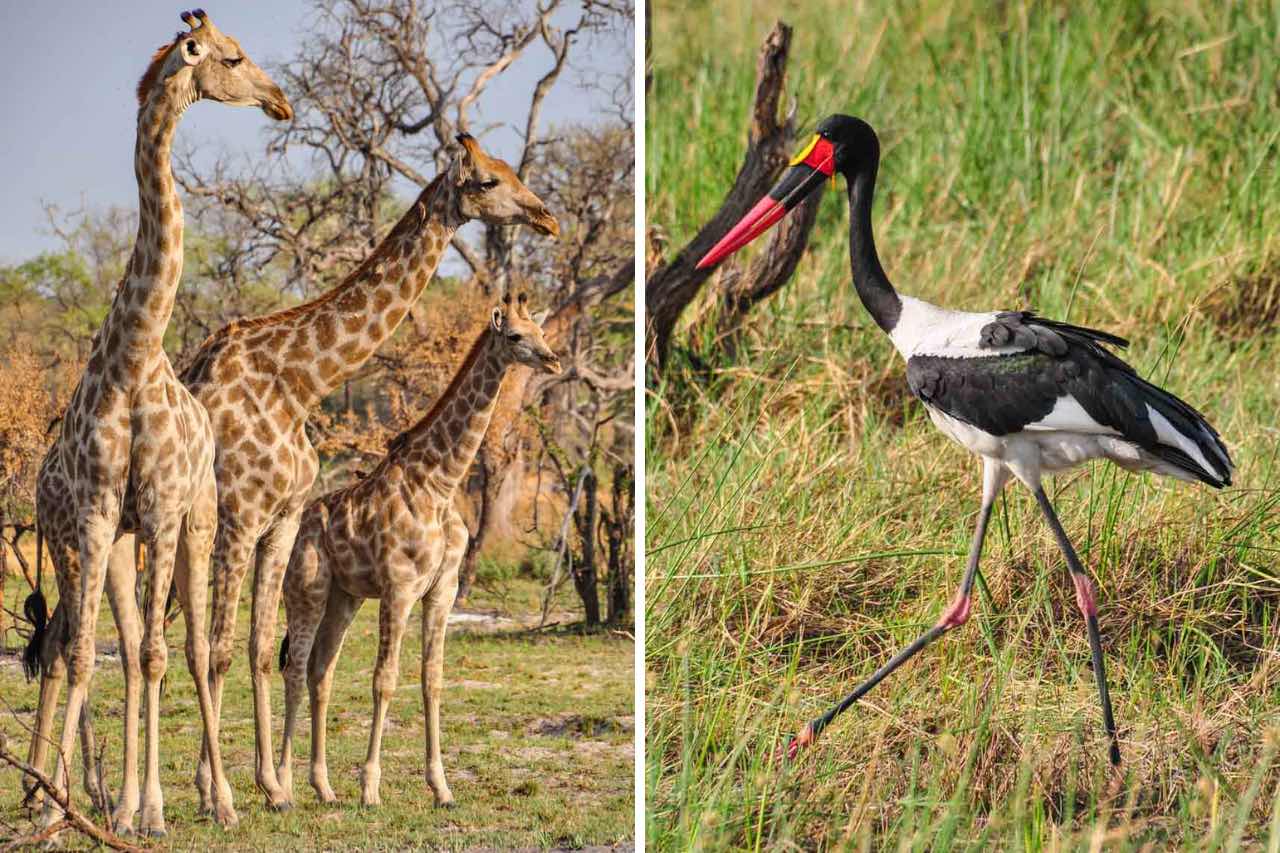
 

An image with two photos: three giraffes of differing sizes and a red-billed black and white stork.

Wildlife seen on the morning game drive – a giraffe family and a saddle-billed stork.


At 9.30 am, we stopped in a clearing in the bush for coffee/tea and muffins. There’s that picnic again! Always welcome after such an early breakfast.

Usually, a game drive lasts three hours, but this one lasted five hours as we had to take a couple of guests to the airstrip for their flight out of Stanley’s Camp. The plane had to abort its first attempt at landing because there were impalas on the airstrip. Once again, we waited for the plane to take off before continuing our game drive.

As I lay on my bed resting between lunch and high tea, I watched monkeys darting around outside my tent and heard antelope (at least I hoped it was antelope) munching on the grass on the other side of my canvas wall.

We spent most of the afternoon game drive looking for lions. Lion tracks could be seen, but there were no lions or any other wildlife, for that matter. However, after two hours of nothing, we came across impalas and giraffes, several warthogs (nature’s ugliest animal?), a lone wildebeest, kudus with their distinctive white stripes down their backs and pink colouring inside large ears, and a large herd of elephants (the largest I have seen so far).

An image of four photos: a baby elephant peeking out between two adult elephants, a warthog, an elephant up close, and a kudu.

Wildlife seen on our afternoon game drive – a baby elephant peeking out between two adult elephants, a warthog, an elephant up close, and a kudu.


As the sun lowered in the sky, a hippo suddenly emerged from the bushes and ran across in front of the vehicle. They can run very fast – no wonder hippos are Africa’s most dangerous animal, with the most human deaths attributed to them. When we rounded the corner of a clump of trees, there was a lagoon with many hippos in it. I was thrilled. Hippos and elephants were what I had come to Botswana for. We stopped by the lagoon for our game-drive coffee and snacks, which I barely had time to consume because I was taking so many photos of the hippos in the lagoon.
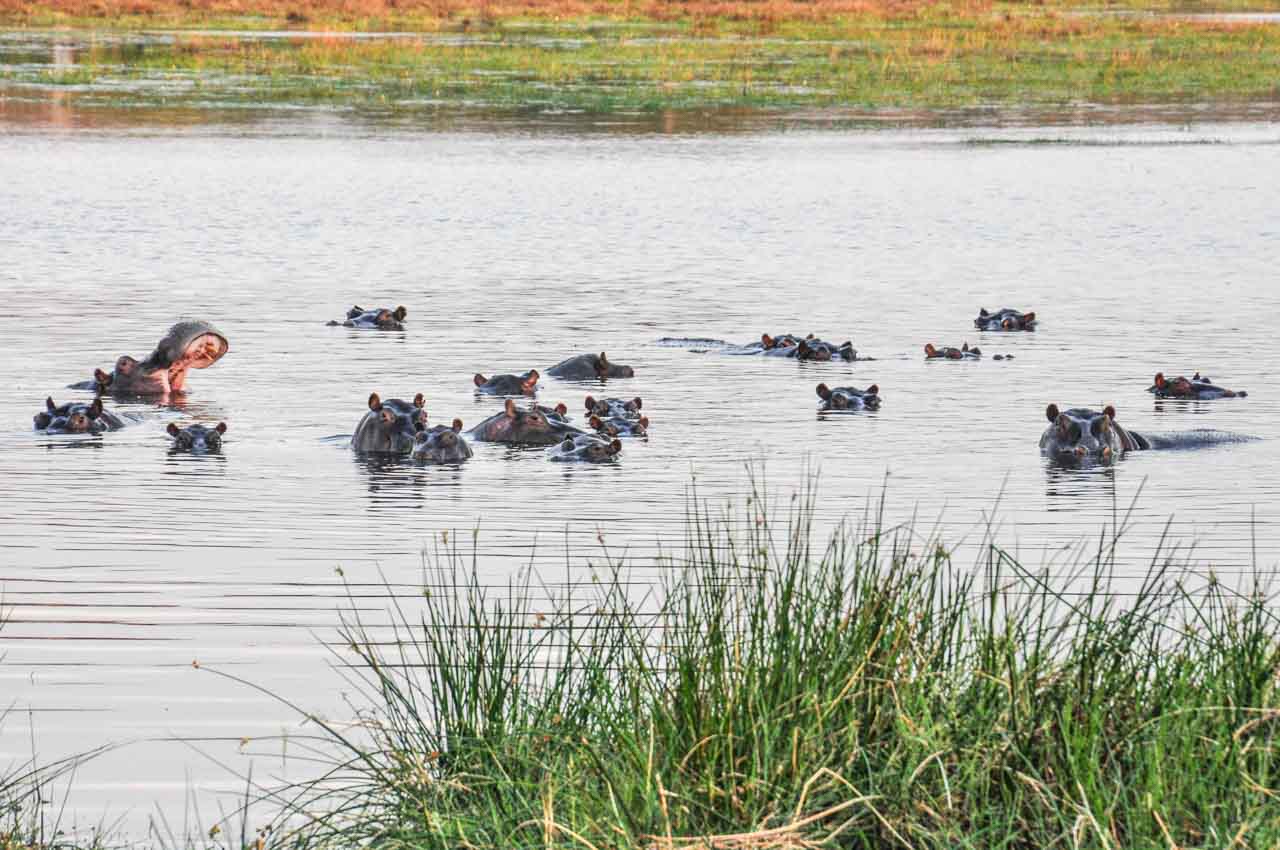
Several hippos are looking towards the camera while submerged in the water. One hippo has his mouth wide open.

A pod of hippos – seen on a game drive in the late afternoon.
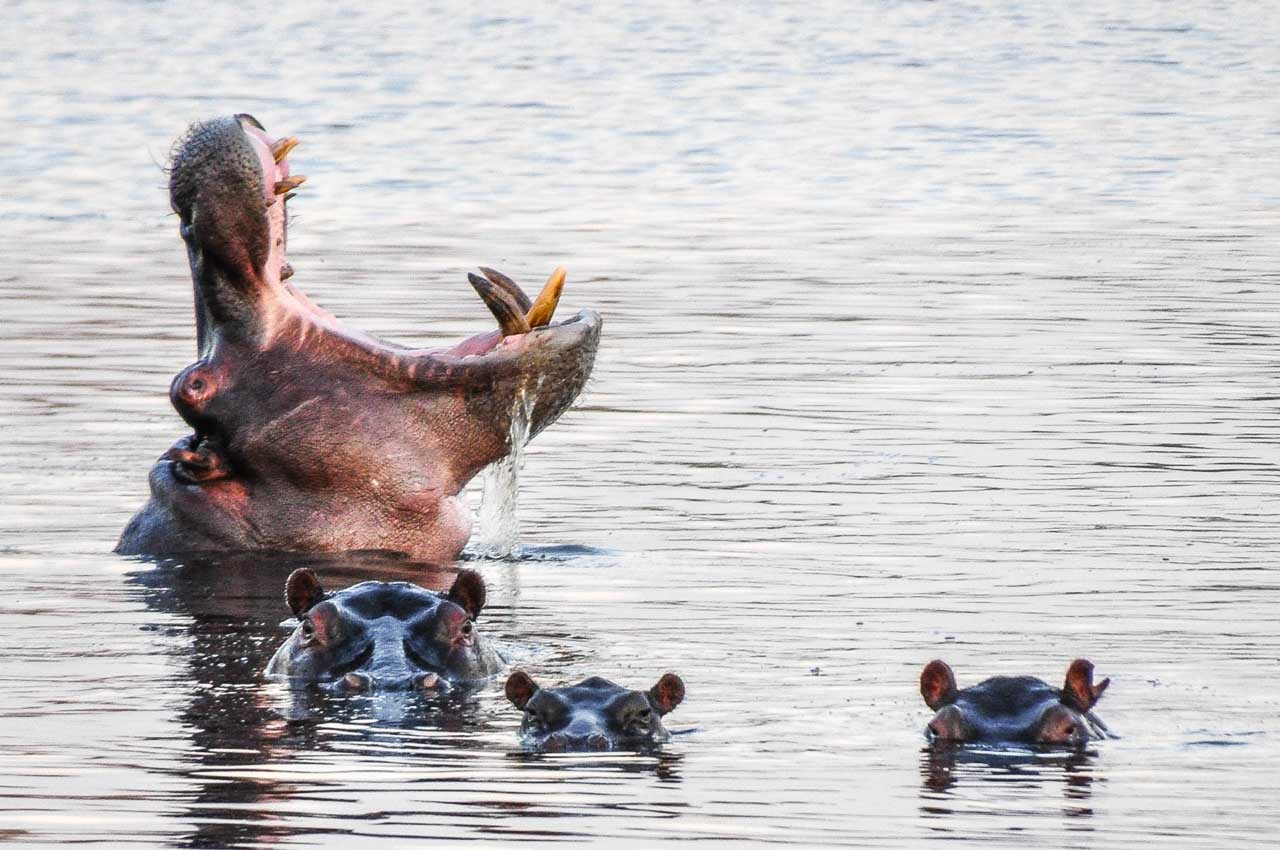
 

Four hippos have just their heads above water while one of the hippos has his mouth wide open, exposing his teeth and jaw.

A male hippo shows his domination by displaying his teeth and jaw.


What I learned today:

  • The darker the patches on a giraffe, the older the giraffe. The giraffes seen this afternoon were very old according to the colour of their patches.
  • The patches on a giraffe are like human fingerprints – the patch patterns are unique to each giraffe, just like the stripes on zebras.
  • Wildebeests are herd animals; seeing one by itself means it is old and has been kicked out by the herd.

Back at camp, I bought a beautifully carved wooden hippo at the camp’s shop to celebrate seeing hippos in the wild. The staff wrapped it tighter than a sausage, binding it in sticky tape to protect it from damage. Customs in Australia will have a hard time opening it to check the wood.

We had dinner tonight under the stars, around the campfire. The sky is unhindered at Stanley’s Camp, and the night sky is a mass of stars.

My second morning’s game drive started with a wake-up call at 5.15 am and leaving camp at 6.00 am before breakfast. The early start was because we were driving to Moremi Game Reserve for our game drive. Since we missed breakfast, the staff had packed extra food for our mid-game drive picnic. So, instead of morning tea, we had brunch.

The game drive through Moremi Game Reserve was uneventful. However, we did see a couple of honey badgers, which is rare.

This day, lunch was not back at camp but was set up in the veld by staff who had brought everything from the kitchen. It was a lovely setting, with zebras roaming in the distance, and a unique experience.

I spent the afternoon reading on my veranda’s daybed while watching two elephants getting closer and closer to my tent.

I must admit that after a couple of days of breakfasts, lunches, dinners, game drive picnics, and high teas, I started skipping meals. We were fed so often at Stanley’s Camp that I just wasn’t hungry by the evening meal.

On my final game drive, I saw elephants, kudus, and heaps of impalas. But the highlight was photographing a leopard chilling out in the branches of a tree.
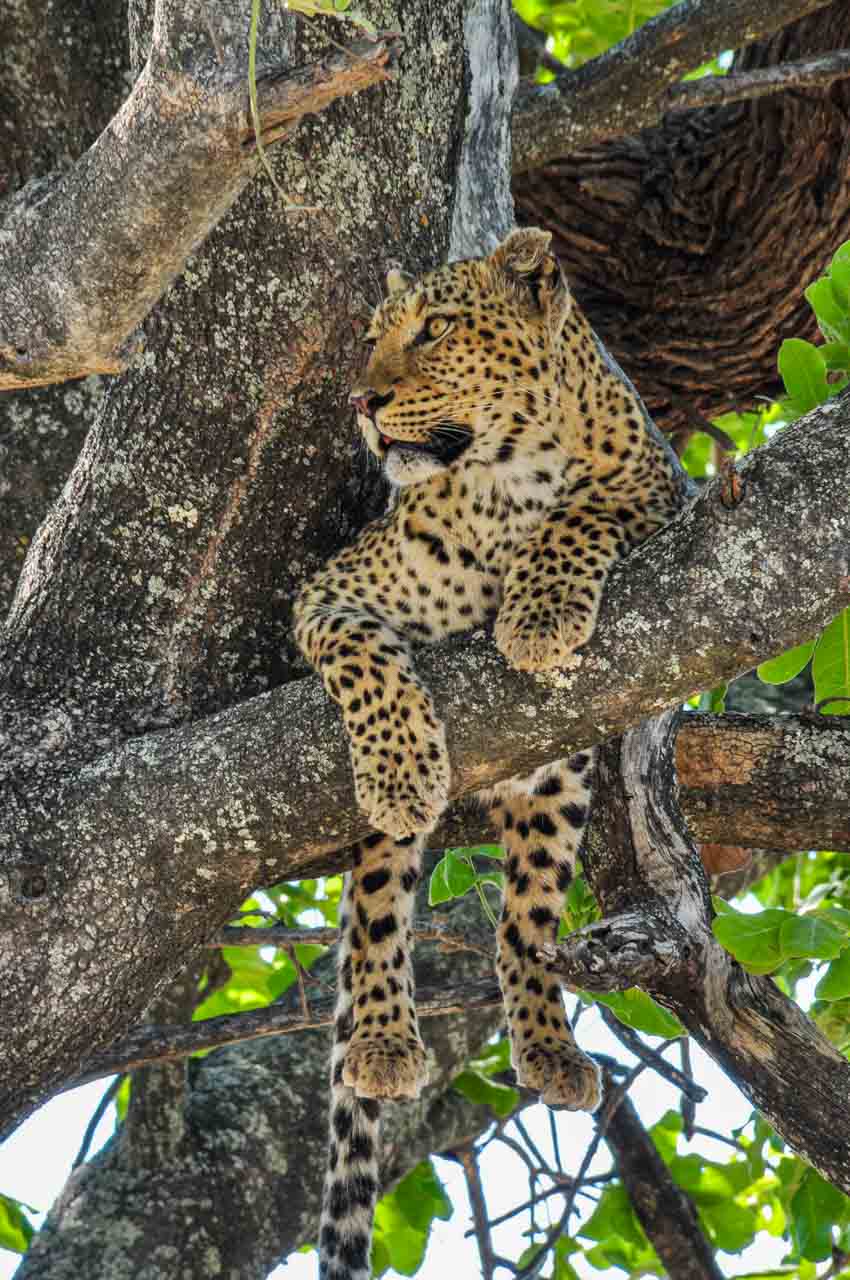
A leopard hangs over a tree branch with his feet and tail dangling down.

A leopard relaxes in a tree as he surveys his territory.


Why I recommend Sanctuary Stanley’s Camp

  1. The accommodation at Stanley’s Camp is glamping at its best. The ‘rooms’ are comfortable and beautifully fitted out, and they are an ideal place to relax and wind down after a game drive when you want time to yourself.
  1. Stanley’s Camp feels intimate, with only ten tents (‘rooms’).
  1. Your tent is situated on the edge of a vast, open plain (veld), offering an uninhibited view of wildlife roaming across it.
  1. The attention provided by the staff was individual and personalised. Having the same guide throughout my stay ensured my needs were met, even when they didn’t have to be! When I opted to forego an afternoon game drive for a rest, my guide arranged for high tea to be brought to my tent. I believe he went above and beyond – meeting my wants rather than my needs. I could not fault the staff and management.
  1. The game drive vehicles at Stanley’s Camp were open-sided, making spotting wildlife much easier. As Sanctuary Stanley’s Camp is on a private concession, we could get up close to animals (always when safe to do so).
  1. Staff care about your welfare. When I got sunburnt (pack the sunscreen!), a staff member phoned its sister camp in the Okavango Delta for sunscreen for me. Unfortunately, there was none to be had! We were travelling on dirt roads on game drives and could be tossed about in the vehicle. When going over particularly rough sections, our guide would turn around and ask if we were all still in the vehicle.
  1. Wherever I travel, I will always seek out high tea venues. When I booked Sanctuary Stanley’s Camp, I was unaware that high tea was included. That it was served every afternoon was a delightful bonus.

Ask yourself, why would you not stay at Sanctuary Stanley’s Camp? From a seasoned traveller and someone who lived in Namibia for several years, I highly recommend a wildlife safari holiday at Stanley’s Camp.

A note on when to go

I travelled to the Okavango Delta in early November. In hindsight, it was not the ideal time to go, as it was very hot and humid due to the late start of the wet season. There was no escaping the heat, something I usually thrive on. My guide told me the temperature over the three full days of my stay had been 38, 41, and 43 degrees Celsius, respectively, with the humidity at 88%. What rain I did see (on my final evening) lasted five minutes and didn’t even wet the ground.

While the timing of seasons can be unpredictable, perhaps it is best to take your African safari in Botswana at the beginning of the wet season rather than at the end!

See here for the best time to visit the Okavango Delta. My trip to Botswana had been a last-minute decision due to an unforeseen need to change travel plans, and I did not consider the weather!


My stay at Sanctuary Stanley’s Camp in Botswana’s Okavango Delta was nothing short of extraordinary. From the luxurious comfort of glamping under the African sky to the thrill of witnessing wildlife in its natural habitat, every moment felt magical. The attentive and warm hospitality from the staff only enhanced my experience, making it feel both intimate and unforgettable. Whether you’re a seasoned safari-goer or a first-timer, Stanley’s Camp offers a perfect blend of adventure and relaxation. It’s a place where nature and luxury harmonise, leaving you with memories that will last a lifetime.

I highly recommend Sanctuary Stanley’s Camp as your destination of choice.


Disclaimer: This post contains no affiliate links. All views and opinions are my own and non-sponsored. Unless specifically stated, all photos are my own and remain the copyright of Joanna Rath/Just Me Travel.

© Just Me Travel 2018-2024. All rights reserved.


Where was your favourite African safari?

I love hearing from you and look forward to reading and responding to your comments. Please join the conversation by leaving a comment below.


Like this post? Save it for Later!
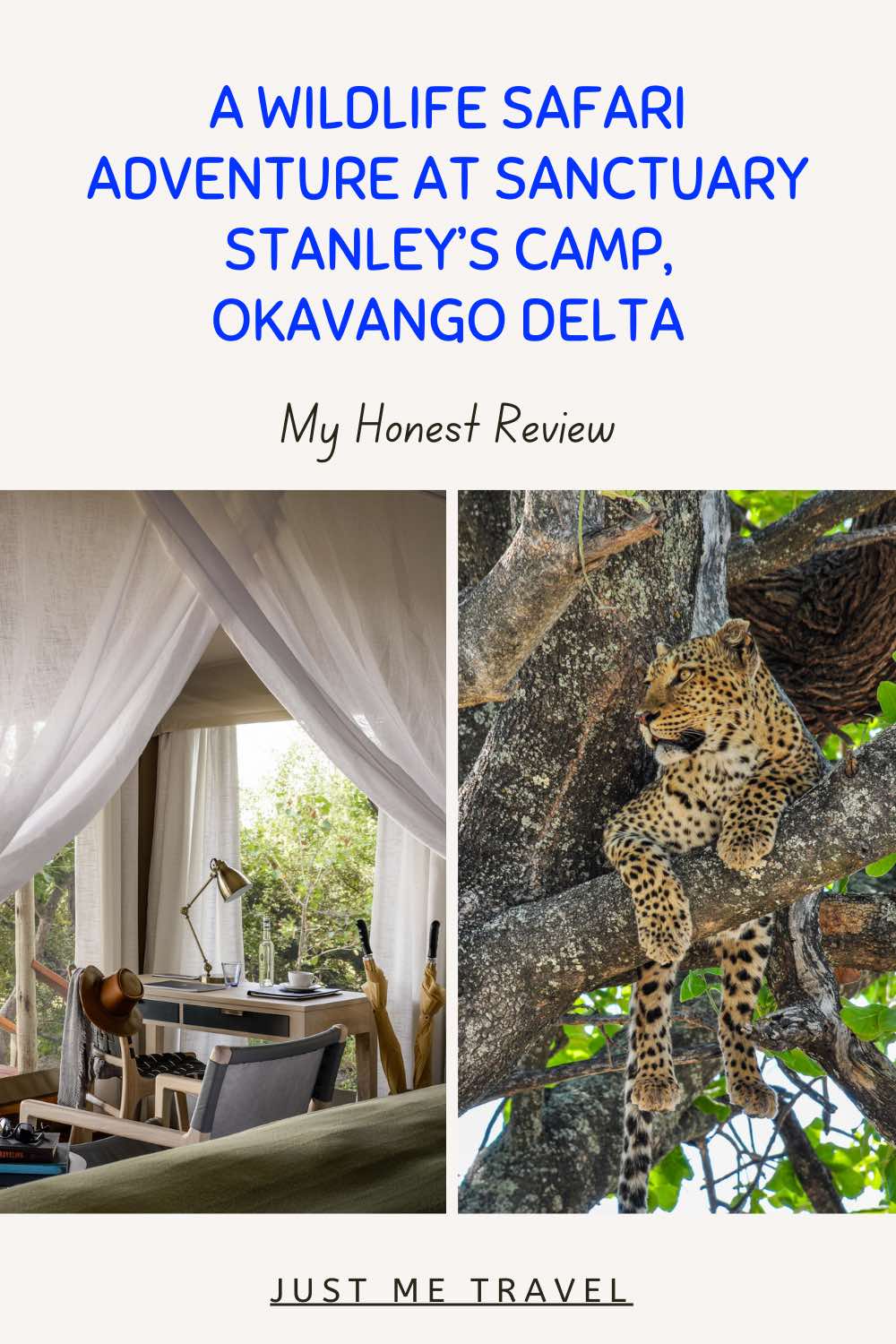
This is an image with two photos: the furnished interior of a luxury tent showing a bed, chair, and desk and a leopard hanging from the branch of a tree.

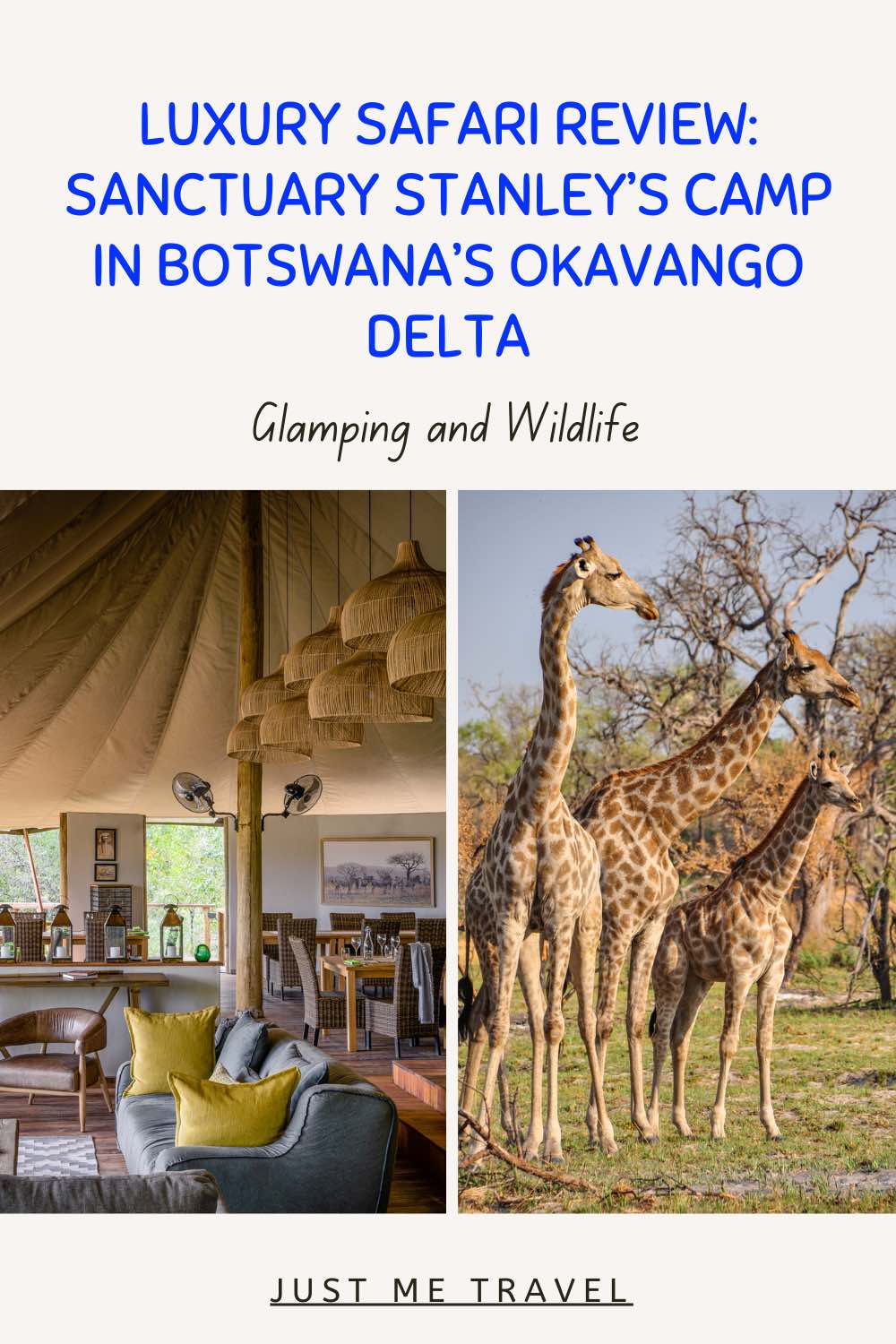
This image has two photos: a large tent furnished with couches, dining tables and chairs, and a bar and a giraffe family (mum, dad, and baby).


Author’s Note: Please check the latest travel restrictions before planning any trip and follow government advice.


Sign up to receive the latest in travel destinations, topics, resources and guides.


You might also like

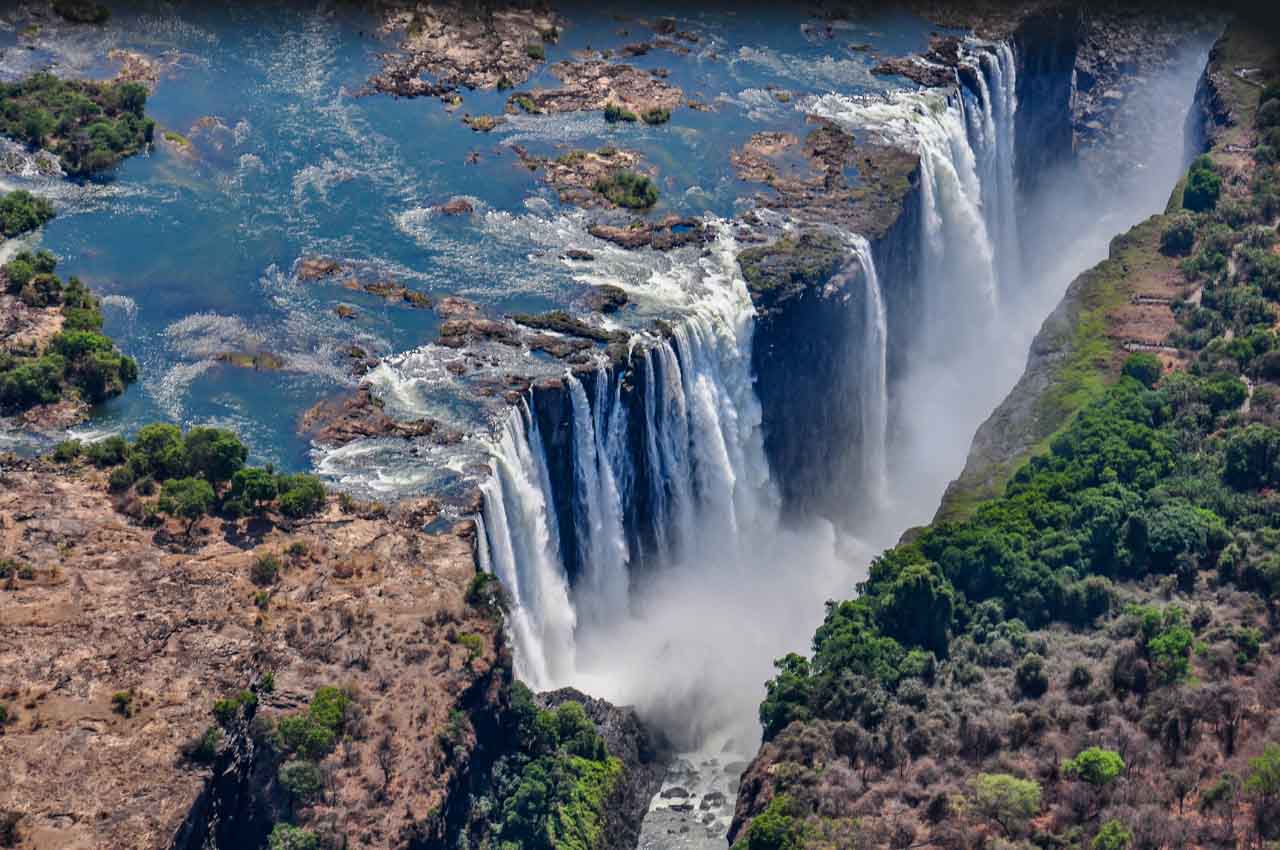
A wide waterfall cascades down the escarpment into the gorge below.SEE THE POWERFUL VICTORIA FALLS BY LAND AND AIR – My Photo Guide (2024 Updated).    See my landscape and aerial photos to inspire you to visit Victoria Falls on the border of Zimbabwe and Zambia. A bucket-list destination!


A large herd of elephants come down to the riverbank to drink.UNIQUE AFRICAN RIVER SAFARI – The Perfect Chobe River Boat Cruise. Join me on my unforgettable two-night Chobe River safari cruise. Experience incredible wildlife encounters that are only possible on a water-based safari.


An image with three photos of a pool surrounded with lounge chairs and umbrellas, an elephant throwing dust over itself, and morning teas served on the bonnet of a jeep.STAY AT LUXURY ZAINA LODGE IN GHANA FOR AMAZING WILDLIFE ENCOUNTERS. Looking for a unique African safari experience? Zaina Lodge is a luxury safari destination in Ghana’s Mole National Park. Explore how to get there, when to visit, and what makes Zaina Lodge stand out. Get inspired for your next journey!


Copyright © Just Me Travel, 2024. All rights reserved.


No Comments on A WILDLIFE SAFARI ADVENTURE AT SANCTUARY STANLEY’S CAMP, OKAVANGO DELTA

SIMIEN MOUNTAINS ETHIOPIA: When “Plastic Card” Means Warmth (Not what you think!) (2024 Updated)

Lost in Translation! Discover How a ‘Plastic Card’ Becomes a Hot Water Bottle in Ethiopia’s Simien Mountains     Dear Pip, Having travelled as much as I have, I should…

Lost in Translation! Discover How a ‘Plastic Card’ Becomes a Hot Water Bottle in Ethiopia’s Simien Mountains


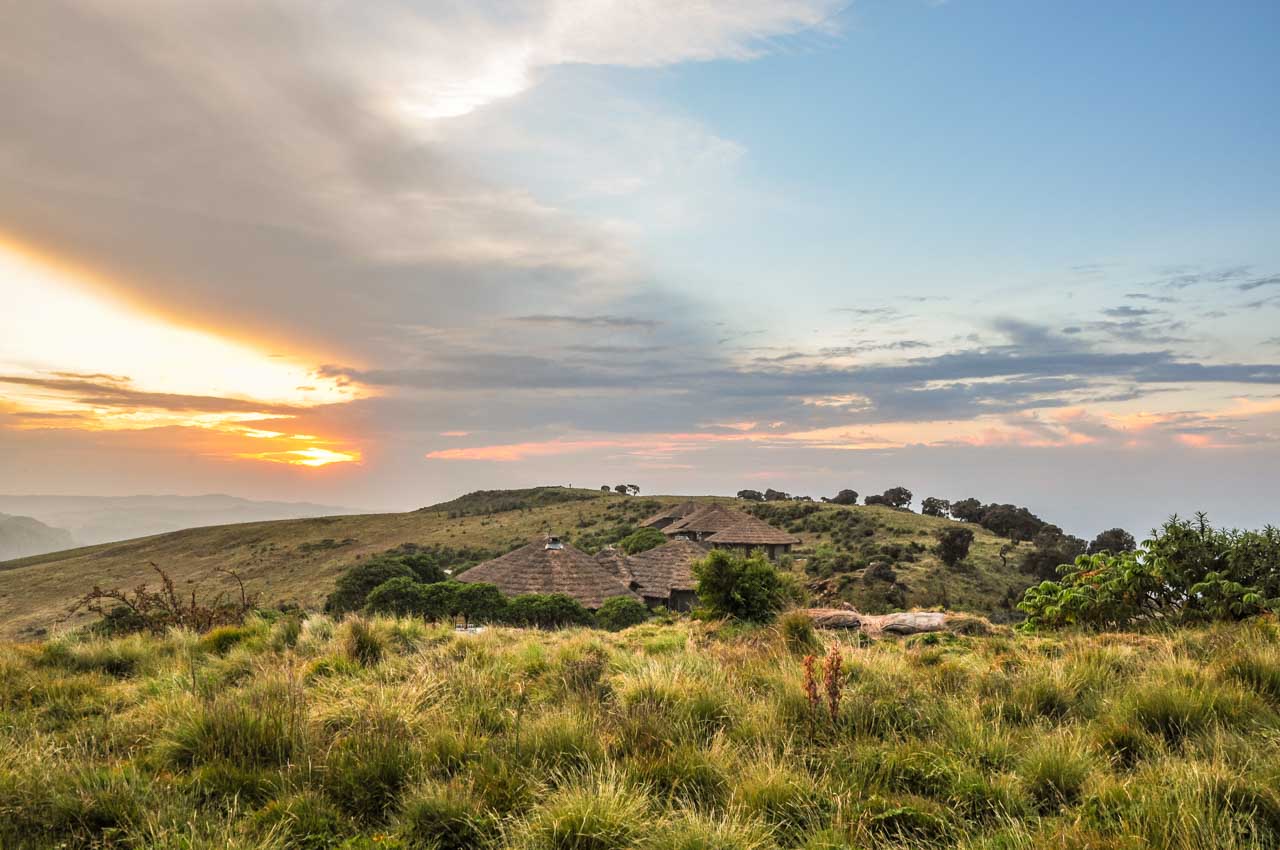
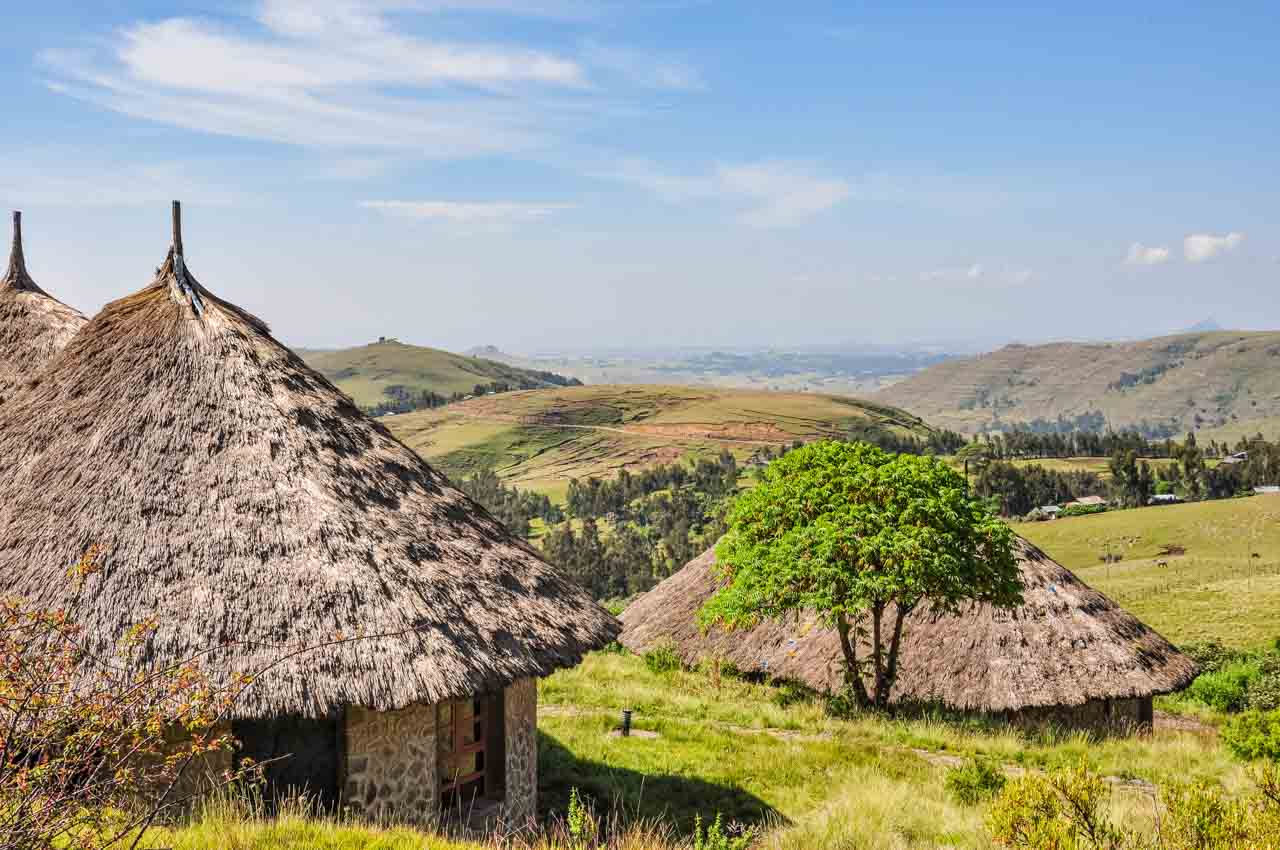
The sun set behind the mountain with several round huts used for accommodation.

Simien Lodge – sunset over the Simien Mountains


Dear Pip,

Having travelled as much as I have, I should no longer be surprised by how easily things can get lost in translation. But on this occasion, my physical comfort, or more precisely, my physical discomfort, enabled me to create my own meaning to communication.

I have arrived at the Simien Lodge in the Simien Mountains National Park. The Lodge is on an escarpment, and the mountain landscape is stunning. However, it was cold, and I needed to find my jacket from the bottom of my bag. This was the first time I needed my jacket since arriving in Ethiopia. It could have something to do with the Simien Lodge being 3,260 metres above sea level – the highest lodge in Africa.

The rooms in the Simien Lodge are spacious, with a good-sized bathroom, including a shower that I was actually able to turn around in (an issue in Ethiopian hotels). But the room was cold, and after a thorough search, I couldn’t find any means of heating it.

Due to arriving at the Simien Lodge after a very long drive (getting anywhere in Ethiopia involves a long drive), I decided a nap was in order. I would worry about the heating when I went down for dinner. Given the altitude and my hut being on top of a hill, I wasn’t going to walk up and down unless I absolutely had to.

Grabbing the blankets and quilts from the spare bed onto mine, I climbed into bed, thinking that at least I would be warm while I slept. How wrong could I be! I was still cold, even with an extra layer of clothes and my jacket. Needless to say, I went down for dinner as soon as the restaurant opened.

My first stop was at reception, where I asked how to heat my room. I was advised that the staff would provide me with “a plastic card for the bed” after dinner. I assumed this would be like a hotel room key card that you slot into a device to activate the room lights; I would slot this card somewhere in the room that I hadn’t yet located, and it would activate an electric blanket. An electric blanket would be most suitable. That it would be an electric blanket I hadn’t seen yet did not register. I should have known – don’t ever assume! The ‘plastic card for the bed’ was a hot water bottle. That I was disheartened by this method of heating my room was an understatement. How was I going to be warm? However, the hot water bottle worked a treat. I was snug in bed all night and had a great night’s sleep. That the room itself was cold mattered not one bit.

Tomorrow, I leave for Gondar, where, I am assured, it will be warmer.

Love,

Joanna

A view of a mountain range with green, brown, blue, and pink colours.

Simien Mountains National Park


Editor’s Note: I originally published this blog post in April 2019 and have updated it for accuracy and comprehensiveness.


Disclaimer: This post contains no affiliate links. All views and opinions are my own and non-sponsored. All photos are my own and remain the copyright of Just Me Travel.

© Just Me Travel 2018-2024. All rights reserved.


Please share your ‘lost in translation’ experience in the comments below. I love hearing from you and look forward to reading and responding to your comments.


Like this post? Save it for later!

A round stone hut with a straw thatched roof set in the mountains.

Several round accommodation huts set in a dip in the hill.


Author’s Note: Please check the latest travel restrictions before planning any trip and follow government advice.


Sign up to receive the latest in travel destinations, topics, resources and guides.


You might also like

A church in the shape of a cross carved downwards in the volcanic rock.SPECTACULAR NORTHERN ETHIOPIA: A Photo Travel Guide from Lalibela to Lake Tana. Explore Northern Ethiopia’s ancient churches, castles, and breathtaking landscapes in this photo-rich travel guide. Discover history, culture, and adventure through stunning images and insightful stories.


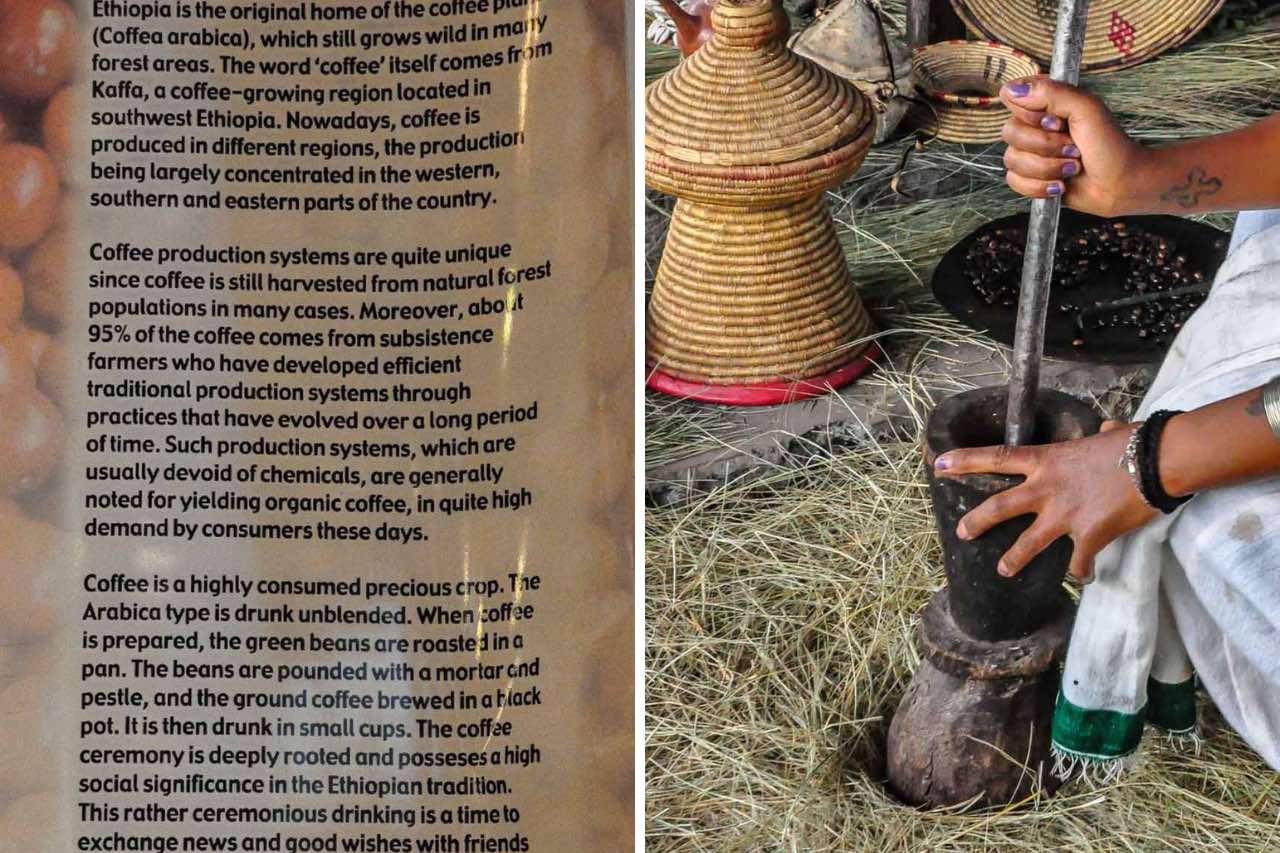
A panel of text telling the story of Ethiopian coffee culture and a woman's hands using a pestle and mortar.UNVEILING THE ETHIOPIAN COFFEE CEREMONY: Experiencing a Perfect Cultural Delight (2024 Updated)

Journey to the birthplace of coffee – Ethiopia – where coffee isn’t just a drink but a ritual steeped in tradition and social significance. Learn the ritual steps of Ethiopia’s coffee ceremony.


A wide waterfall raised white clouds of mist as it plunges into a natural pool.DISCOVER WHY BLUE NILE FALLS SHOULD TOP YOUR ETHIOPIA BUCKET LIST. Step into my visit to Blue Nile Falls in Ethiopia – a simple boat ride, a scenic walk, and an unforgettable moment in one of Africa’s great landscapes.


1 Comment on SIMIEN MOUNTAINS ETHIOPIA: When “Plastic Card” Means Warmth (Not what you think!) (2024 Updated)

UNVEILING THE ETHIOPIAN COFFEE CEREMONY: Experiencing a Perfect Cultural Delight (2024 Updated)

Ethiopia’s Coffee Ceremony is Deeply Rooted in Tradition and Social Significance.   Journey to the birthplace of coffee itself – Ethiopia – where coffee isn’t just a drink but a…

Ethiopia’s Coffee Ceremony is Deeply Rooted in Tradition and Social Significance.


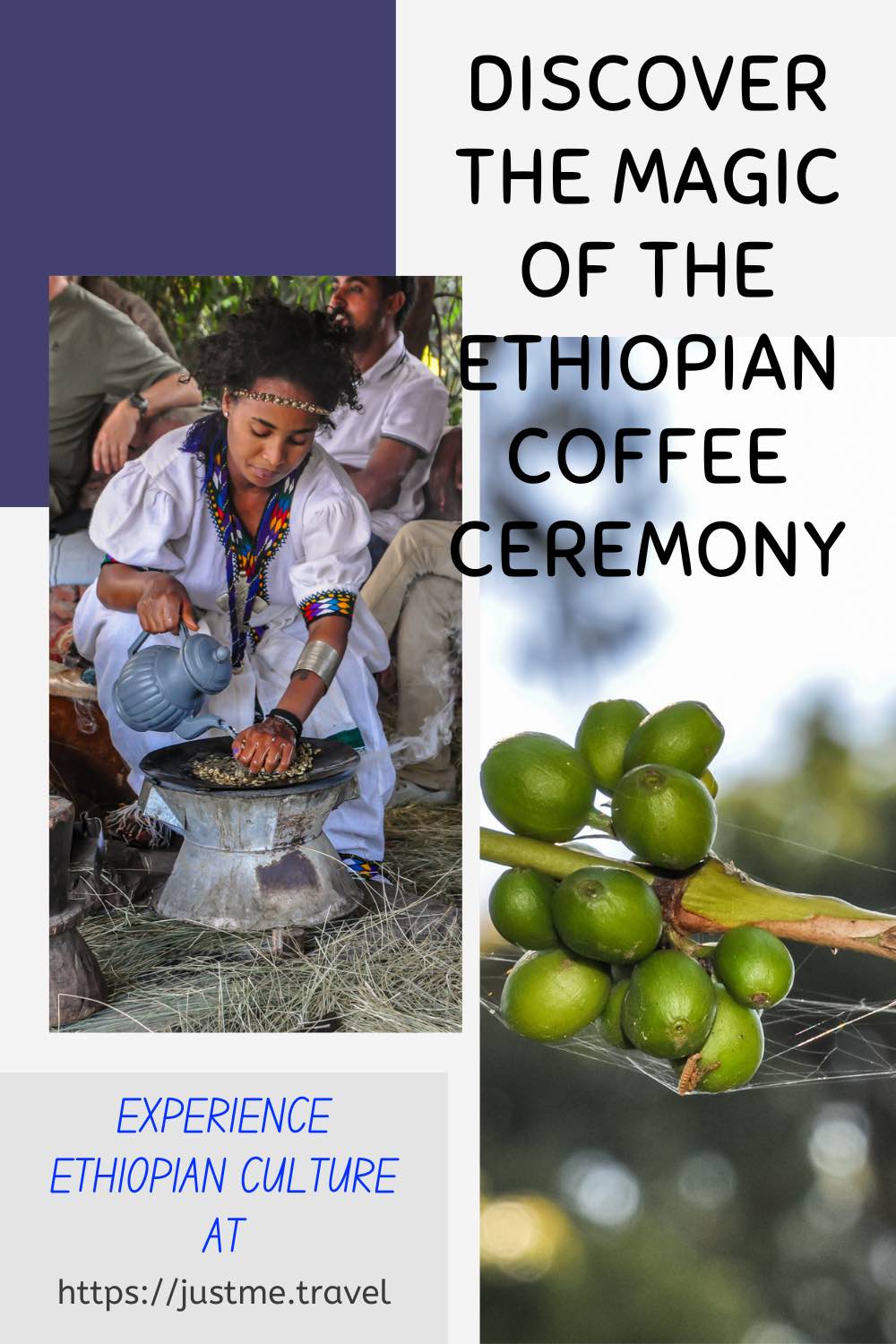
Journey to the birthplace of coffee itself – Ethiopia – where coffee isn’t just a drink but a ritual steeped in tradition and social significance. This is the Ethiopian coffee ceremony, where time stands still to honour hospitality and respect, strengthen bonds, and foster conversations.

This post illustrates this timeless ritual, from the meticulous preparation of the coffee to the communal enjoyment that follows. Get ready to be immersed into the heart and soul of Ethiopian culture through its world-renowned coffee ceremony. It is a truly wonderful and unique experience!


I love coffee. I have drunk it in many countries with varying degrees of appreciation. Well, now I have found coffee heaven. It’s in Ethiopia, and there is a whole ceremony surrounding its making and drinking.

Ethiopia is the home of coffee. The coffee plant originated in Ethiopia, with the beans first brewed in the 11th century. So, Ethiopians have had a lot of practice doing stuff with coffee, to the point where a whole ceremony developed around brewing and drinking coffee. The coffee ceremony is an integral part of Ethiopian culture and hospitality. It is a significant social occasion.

Ethiopians have a delightful story around the discovery of the benefits of coffee. A goat herder noticed his goats acting excitedly and ‘dancing’ on their hind legs after eating the bright red berries from a particular tree. When he tried the berries himself, he felt energised. He grabbed some berries and rushed home to tell his wife, who told him he must share these “heaven-sent” berries with the monks in the nearby monastery. The monks did not share the goat herder’s elation, believing the berries to be sinful and the work of the Devil. They tossed the coffee berries into the fire. However, the smell of the roasting coffee beans made the monks rethink their view of this sinful drug, and they removed the coffee beans from the fire. They crushed the coffee beans to extinguish the glowing embers and covered them with hot water to preserve them. The aroma of the coffee made all the monks want to try it. After this, they vowed to drink coffee every day because they found the coffee’s uplifting effects helped keep them awake during their holy devotions. And so, Ethiopia’s coffee tradition and culture were created.

I loved the ceremony as much as the coffee itself. Unlike Italy, where coffee is drunk quickly whilst standing, preparing and drinking coffee in Ethiopia is not to be rushed as the hostess must not miss any step.

Wherever I travelled in Ethiopia, the coffee ceremony was always the same. There was something reassuring in this familiarity of freshly roasting coffee beans and the smell of fresh-cut grasses that were invariably laid on the ground. The laying of cut grasses on the floor sets the scene for the coffee ceremony.

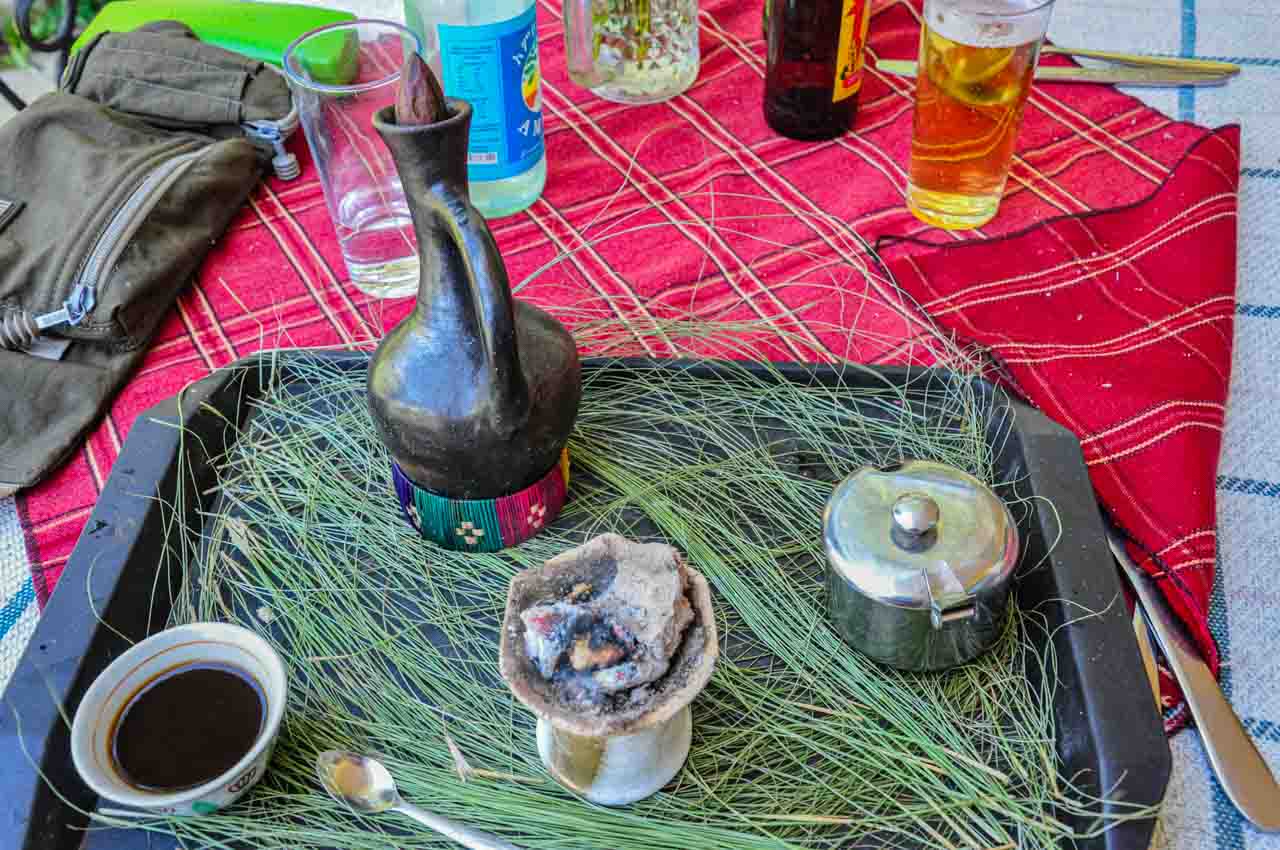
When ordering coffee in a Western-style restaurant in Ethiopia, the coffee is brewed following the established ritual in a reserved area of the restaurant and served on a tray lined with fresh-cut grasses.

A tray sprinkled with green grasses and laid with coffee, a coffee pot, a sugar bowl, and hot coals.

Coffee is served on a tray with fresh-cut grasses.


Ethiopian coffee ceremony: the traditional steps

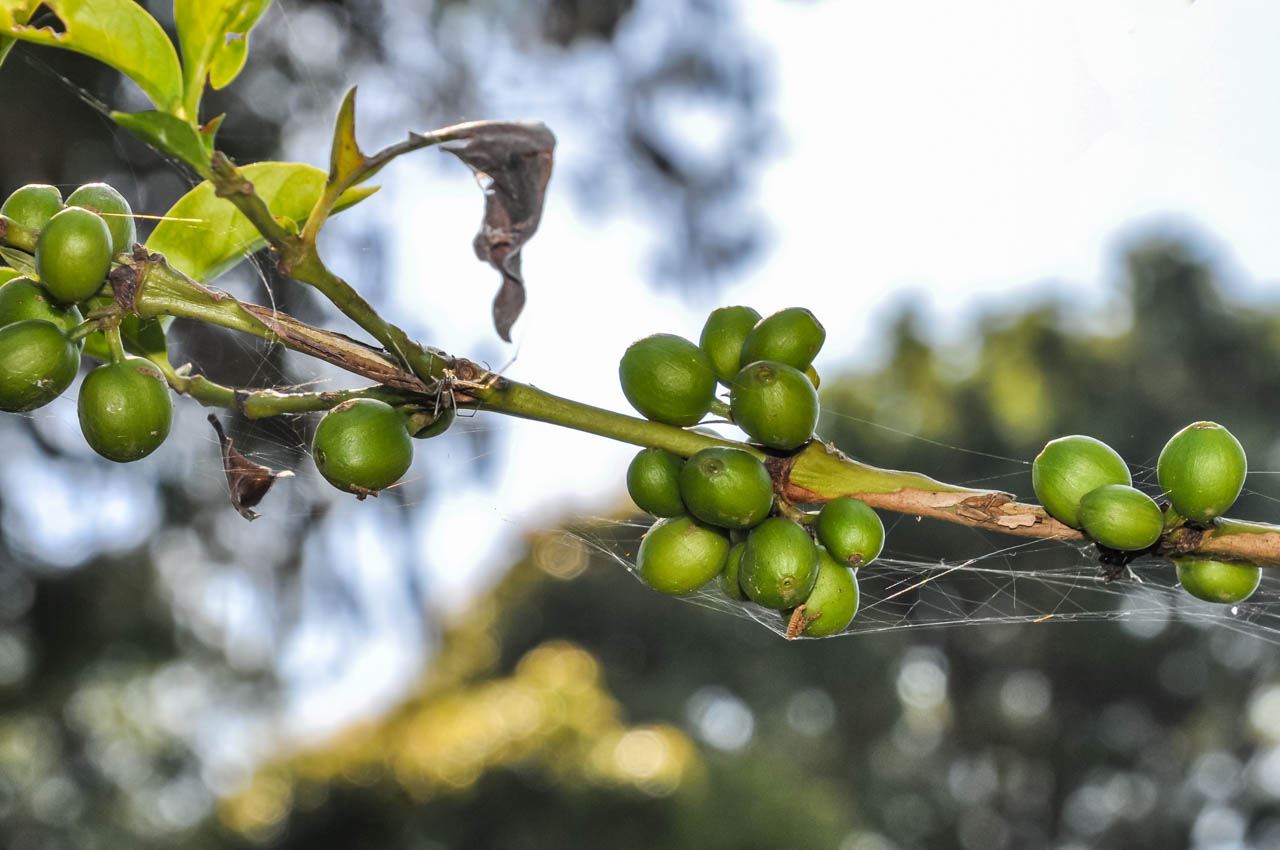
A tree branch with green coffee berries growing on it.

Coffee berries growing on the tree.


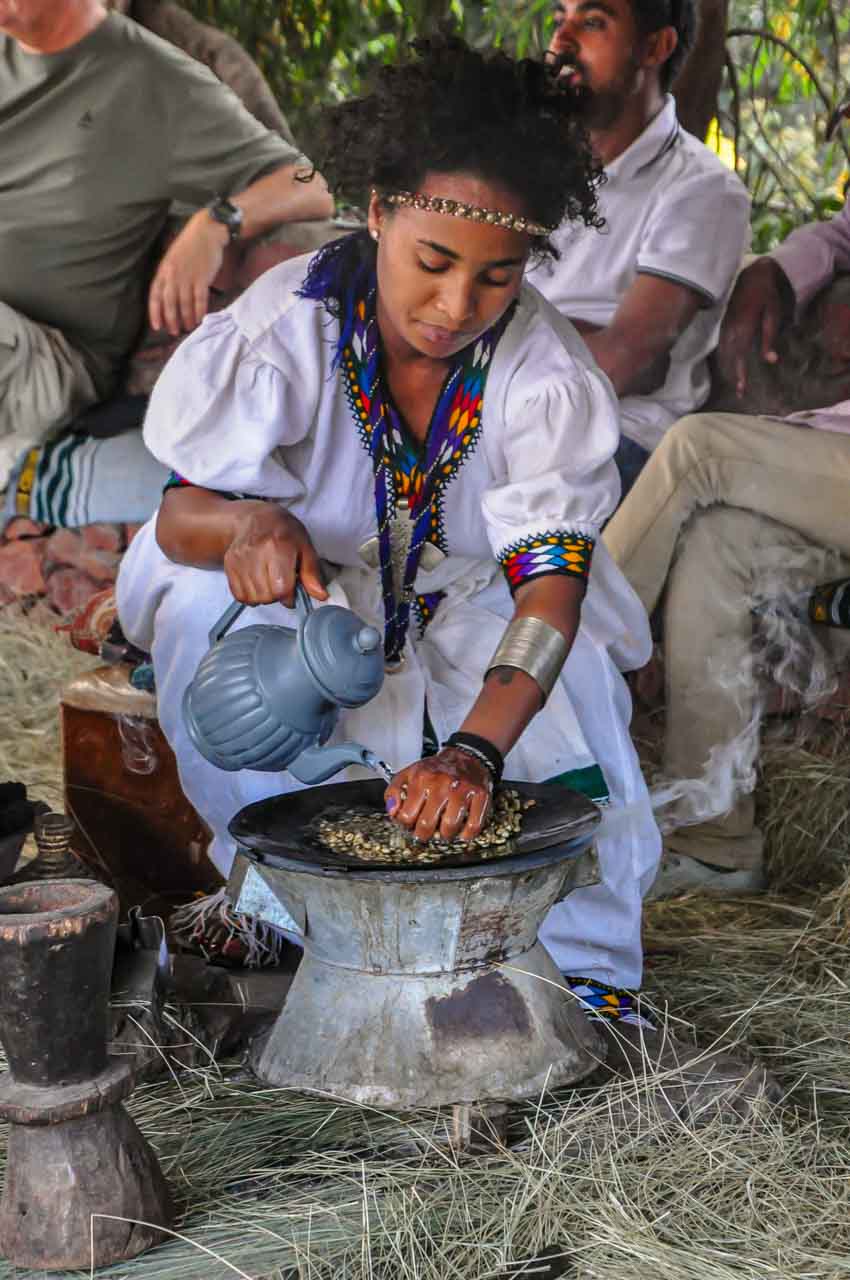
First, the raw coffee beans are rubbed together in water in a pan to remove the skins on the beans. Then, they are roasted over a charcoal brazier, releasing the aromatic oils from the beans. The hostess – I never saw this ceremony conducted by a man – brings the pan of smoking, roasted beans around for you to waft the smoke towards you, to draw in the aroma of the roasted beans.

A woman in a white dress pours water from a pot over coffee beans to remove the shells.

Washing the raw coffee beans.


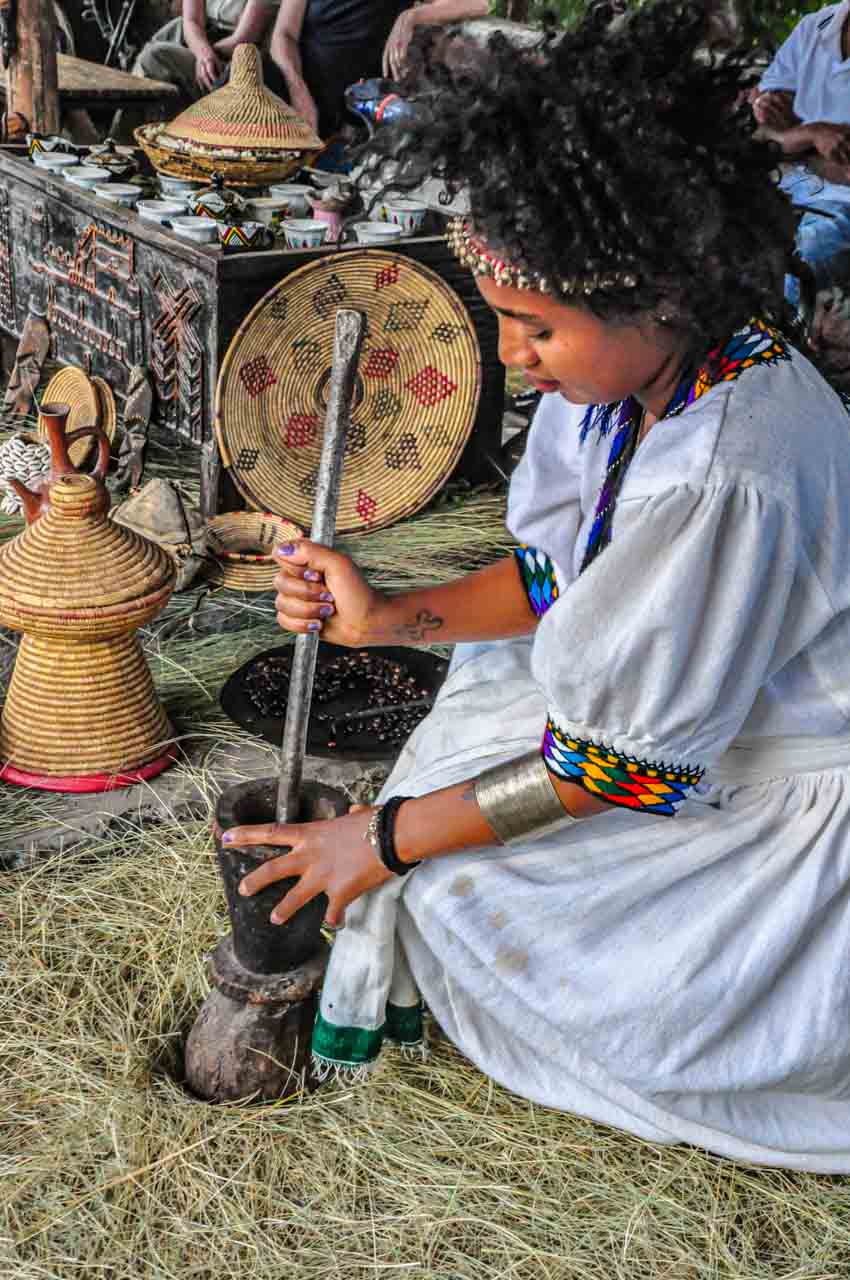
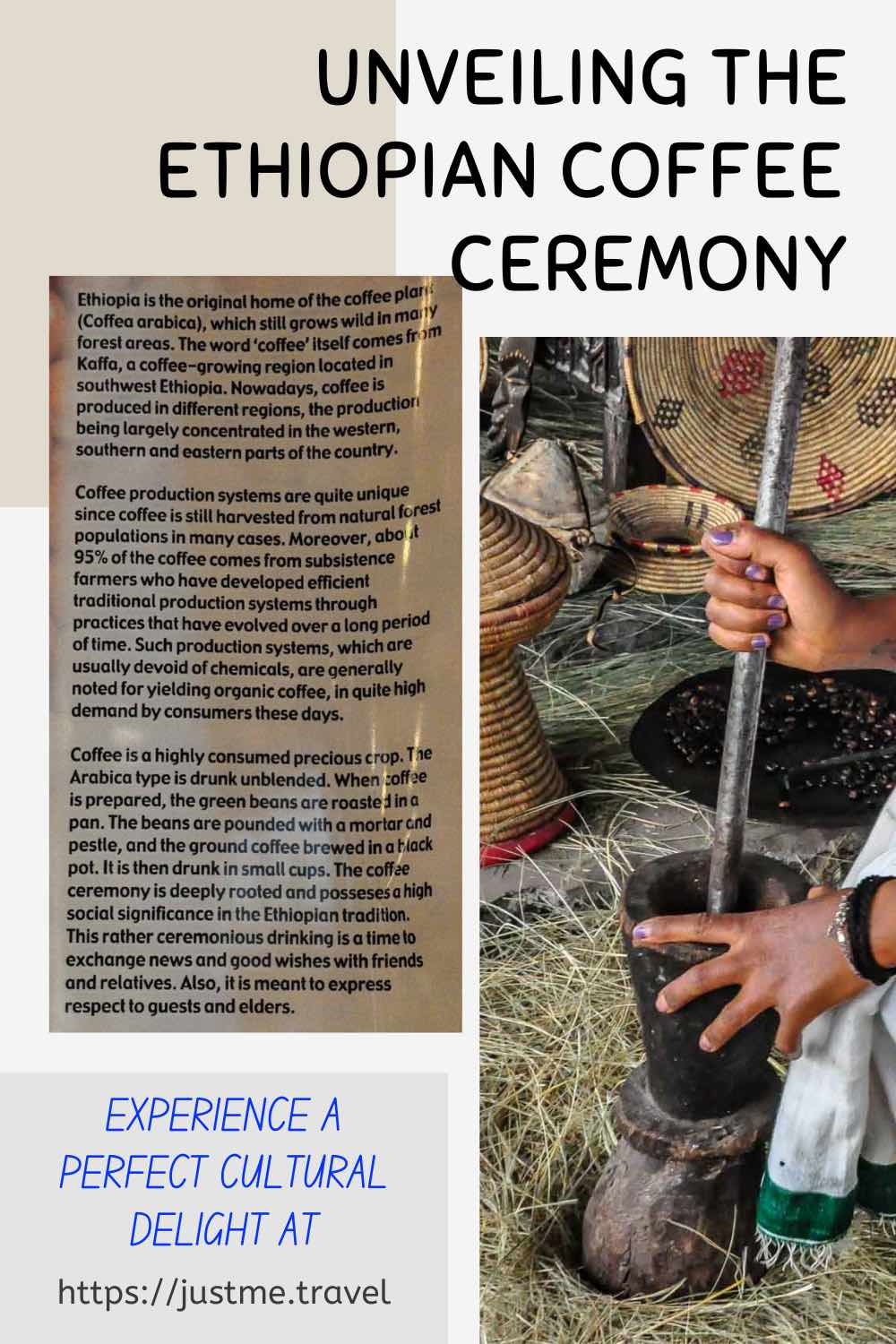
Once roasted, the beans are ground with a mortar and pestle. Traditionally, the mortar and pestle are made of wood.

A woman in a white dress uses a pestle and mortar to grind coffee beans in and Ethiopian coffee ceremony.

Grinding the roasted coffee beans.


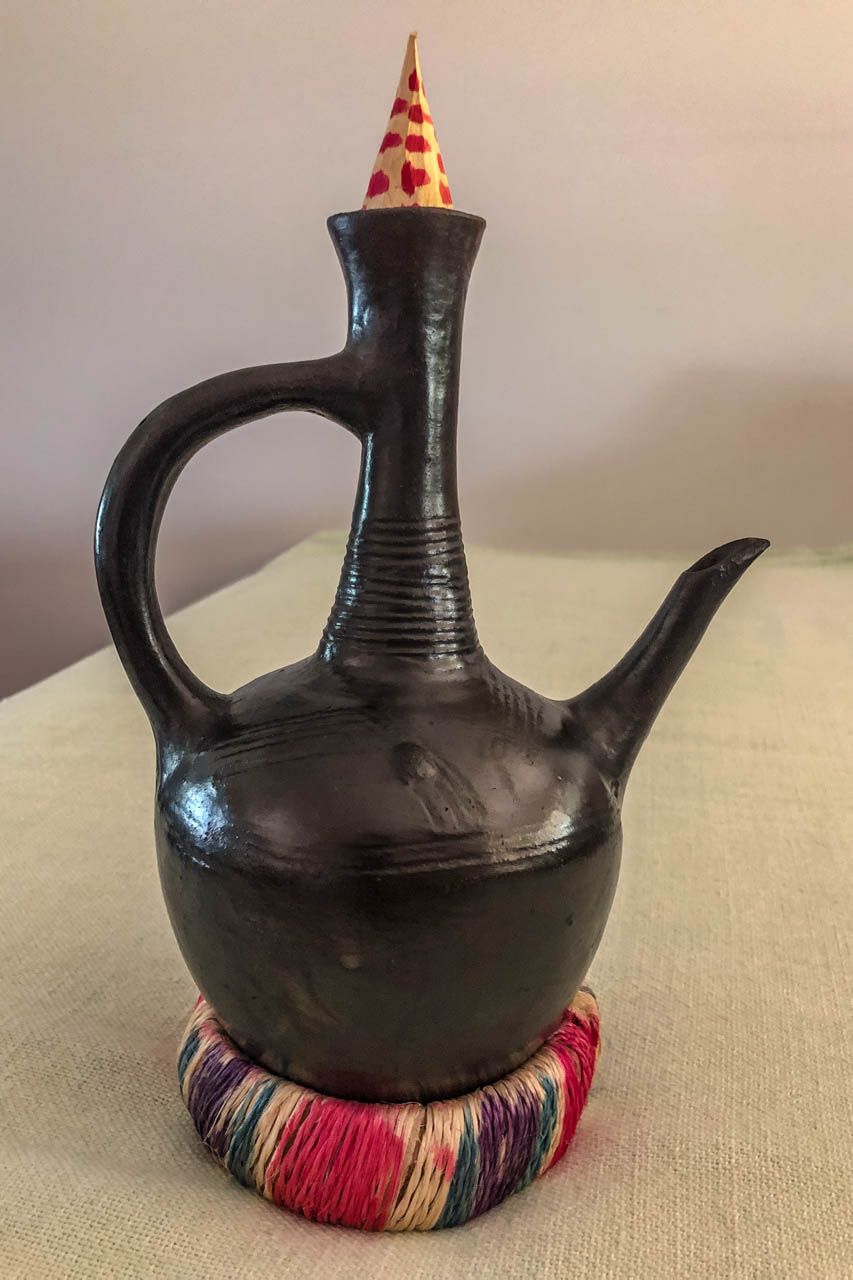
While grinding the beans, the hostess is boiling water in a terracotta “jebena” over an open fire. A jebena is a traditional Ethiopian clay coffee pot with a bulbous, round bottom, a long, narrow neck topped with a wooden or straw stopper, and a handle.

A traditional Ethiopian coffee pot with its round body and long neck.

The jebena I bought in a local market in Bahir Dar.


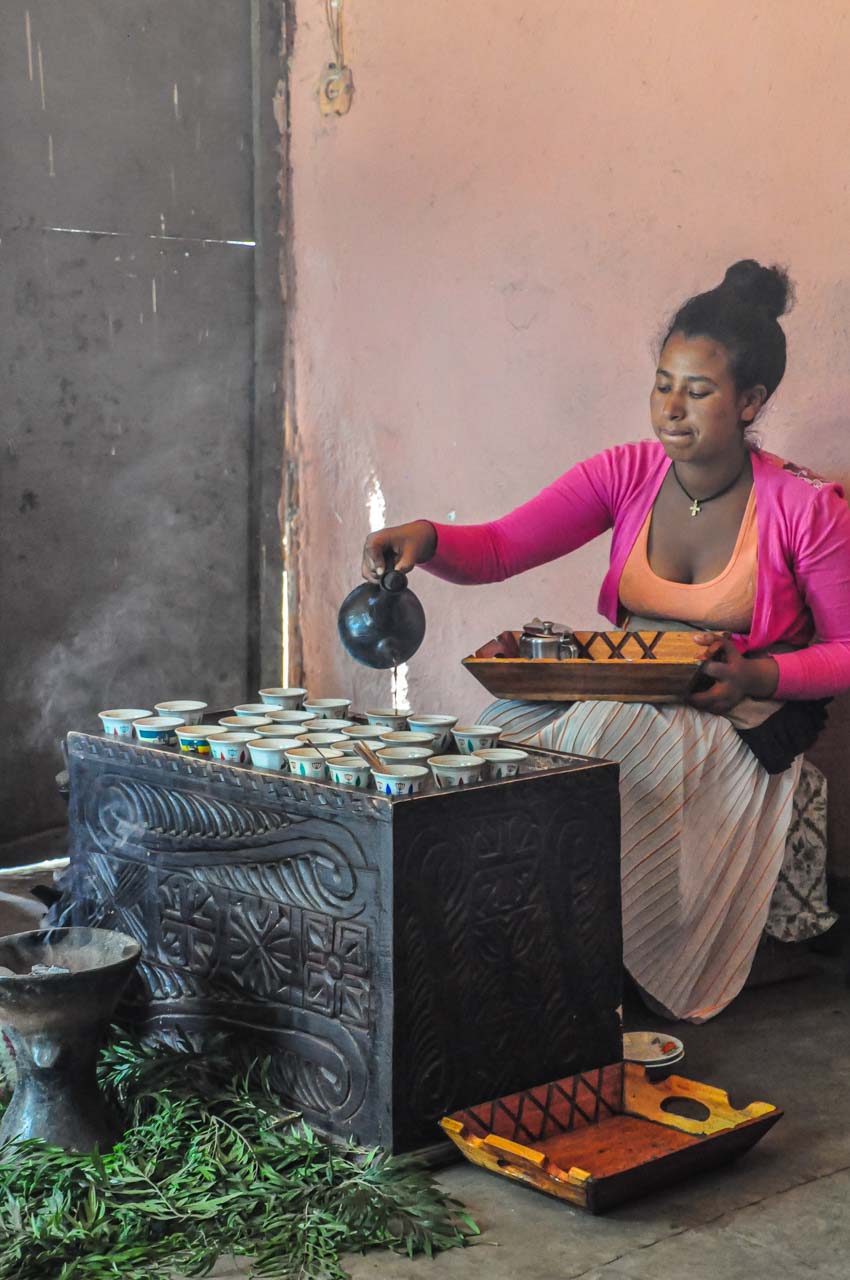
Once the coffee beans are ground, the resultant powder is added to the boiling water in the jebena. The combined water and ground beans are boiled for a couple of minutes and then rested to allow the coffee powder to sink to the bottom of the pot.

By this stage, if you are a coffee lover like me, the smell of freshly brewed coffee will have your mouth watering in anticipation of what will come.

Finally, the coffee is poured into small, handleless porcelain cups (similar to Chinese tea cups). The pouring is done from as high as possible above the cups – about a foot above the cups. The hostess will usually serve coffee with popcorn or peanuts.

Ethiopian coffee ceremony: a social event

Coffee isn’t just a drink in Ethiopia. It is an essential component of Ethiopian culture and society. Being invited to coffee in Ethiopia is considered a sign of friendship and respect. It is a time to extend the hand of hospitality, promote social relations, and catch up on neighbourhood news.

Ethiopian coffee is drunk sweet, and black. In fact, very sweet – 2 to 3 teaspoons of sugar. Mind you, the teaspoons are minuscule. I learnt to enjoy black coffee. However, by the time I left Ethiopia, I was drinking my coffee with a lot less sugar.

When drinking coffee in Ethiopia, etiquette requires you to have three cups of coffee. The first cup is to welcome you, the second is about friendship, and the third is to say goodbye. Denying coffee at any of the three servings is considered rude. Remember, these are tiny cups, so having three is less in quantity than a mug of coffee.

Ethiopian coffee is the best I have ever tasted. The two women I was travelling through Ethiopia with told me I said, “Oh, that’s good coffee”, every time I had a cup of coffee. This must have driven them mad because we had lots (and I mean lots) of cups of coffee. Finally, one of my travel companions told our diver-guide that Ethiopia needs to change its tourism slogan from “13 Months of Sunshine” to “Oh, That’s Good Coffee”. He just laughed.

So, if you ever find yourself in Ethiopia, immerse yourself in the magical and captivating experience of the coffee ceremony. You won’t be disappointed!

To learn about Ethiopia’s coffee ceremony’s cultural and social history, visit the Institute of Ethiopian Studies Ethnological Museum in Addis Ababa. This well-organised, delightful museum on Addis Ababa University’s main campus is dedicated to preserving, studying, and presenting Ethiopia’s rich cultural heritage.

The Ethnological Museum is open daily, excluding public holidays, with entrance fees charged at different rates for adults, students, and those wanting to take photographs. Engage one of the available guides who provide valuable information and insights about the museum’s collections.

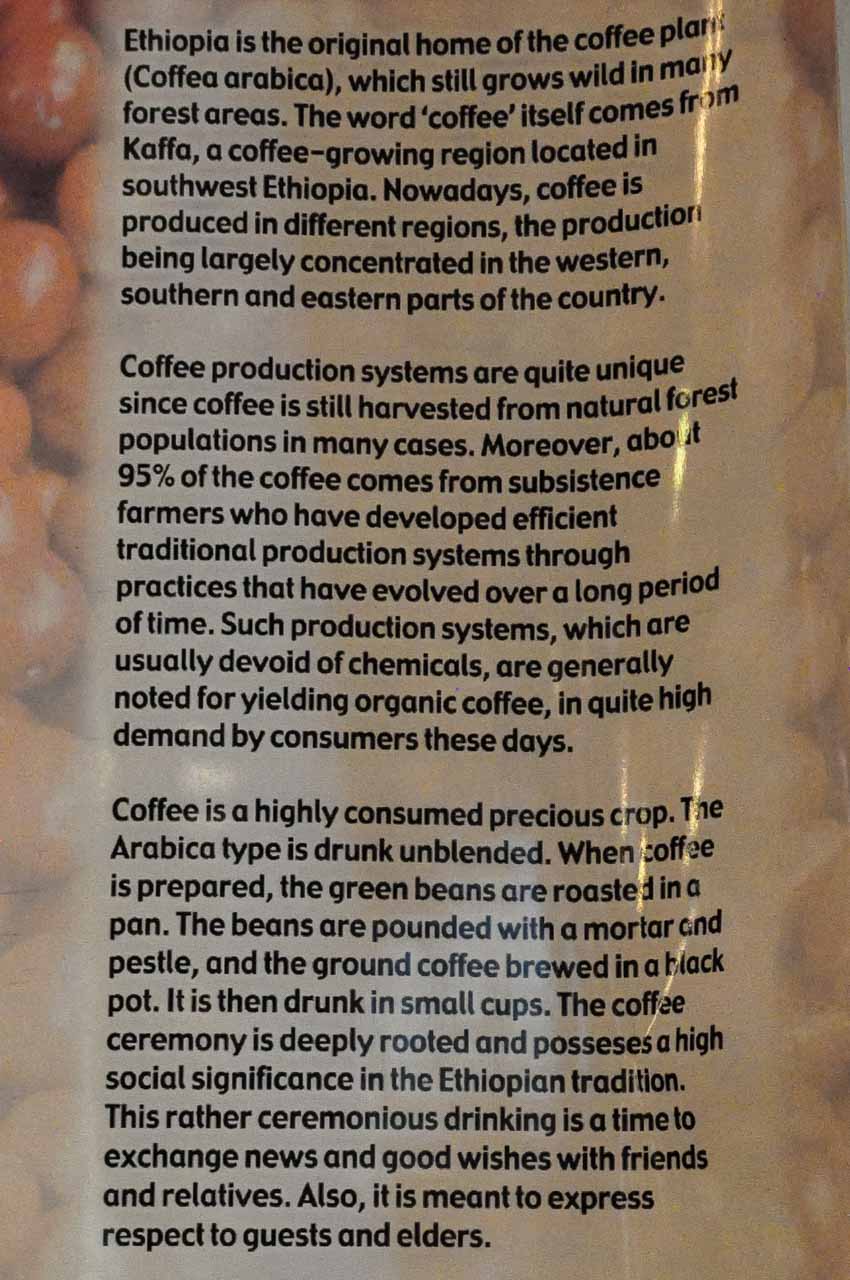
A panel of text telling the story of Ethiopian coffee culture.

The Coffee Story, Ethnological Museum.


From the first crackle of roasting beans to the three rounds of shared cups, the Ethiopian coffee ceremony is more than a mere caffeine fix. It is a ritual filled with tradition, hospitality, shared moments, and a deep appreciation for the humble coffee bean. 

The ceremony unfolds in deliberate steps: roasting beans over coals, grinding them by hand, and brewing them in a traditional pot. Each step contributes to the welcoming atmosphere and deep-rooted traditions that define the Ethiopian coffee ceremony. 

Whether you have experienced it firsthand or are curious about it from afar, the Ethiopian coffee ceremony stands as a testament to the beauty of cultural rituals and the power of a shared cup of coffee to bring people together, wherever they may be.


Editor’s Note: I originally published this blog post in March 2019 and have updated it for accuracy and comprehensiveness.


Disclaimer: This post contains no affiliate links. All views and opinions are my own and non-sponsored. All photos are my own and remain the copyright of Just Me Travel.

© Just Me Travel 2018-2024.


Where have you had the best cup of coffee? What made it so great?

I love hearing from you. Join the conversation and leave a comment below.


Like this post? Save it for Later!
A woman washing coffee beans with water from a jug and green coffee berries growing on a branch.

A poster with text telling the story of Ethiopian coffee culture and a woman using a mortar and pestle.


Author’s Note: Please check the latest travel restrictions before planning any trip and follow government advice.


Sign up to receive the latest in travel destinations, topics, resources and guides.


You might also like

A church in the shape of a cross carved downwards in the volcanic rock.SPECTACULAR NORTHERN ETHIOPIA: A Photo Travel Guide from Lalibela to Lake Tana. Explore Northern Ethiopia’s ancient churches, castles, and breathtaking landscapes in this photo-rich travel guide. Discover history, culture, and adventure through stunning images and insightful stories.


Stone huts with thatched roofs in a mountainous landscape.SIMIEN MOUNTAINS ETHIOPIA: When “Plastic Card” Means Warmth (Not what you think!) (2024 Updated)

International travel will inevitably lead to translation challenges. Read about my communication issue in Ethiopia’s Simien Mountains, which I can laugh about now but, at the time, impacted my physical comfort.


A wide waterfall raised white clouds of mist as it plunges into a natural pool.DISCOVER WHY BLUE NILE FALLS SHOULD TOP YOUR ETHIOPIA BUCKET LIST. Step into my visit to Blue Nile Falls in Ethiopia – a simple boat ride, a scenic walk, and an unforgettable moment in one of Africa’s great landscapes.


3 Comments on UNVEILING THE ETHIOPIAN COFFEE CEREMONY: Experiencing a Perfect Cultural Delight (2024 Updated)

OUIDAH VOODOO FESTIVAL IN BENIN – a joyous celebration with 13 photos to inspire [2021 UPDATED]

An Annual Celebration Not to Be Missed is Benin’s Voodoo Festival in Ouidah   Picture colour, music, singing, dancing, and a joyous party attracting national and international visitors. This is…

An Annual Celebration Not to Be Missed is Benin’s Voodoo Festival in Ouidah


Picture colour, music, singing, dancing, and a joyous party attracting national and international visitors. This is not Carnival in Rio de Janeiro or Venice. Add religion and culture, and you have Benin’s Voodoo Festival in Ouidah. With 13 photos to inspire your curiosity, wanderlust, and travel plans, join me in my experience of Benin’s Voodoo Day national celebration.


Voodoo Day in Benin falls on January 10 each year. It is a national holiday celebrating the country’s heritage of the West African religion of Voodoo.

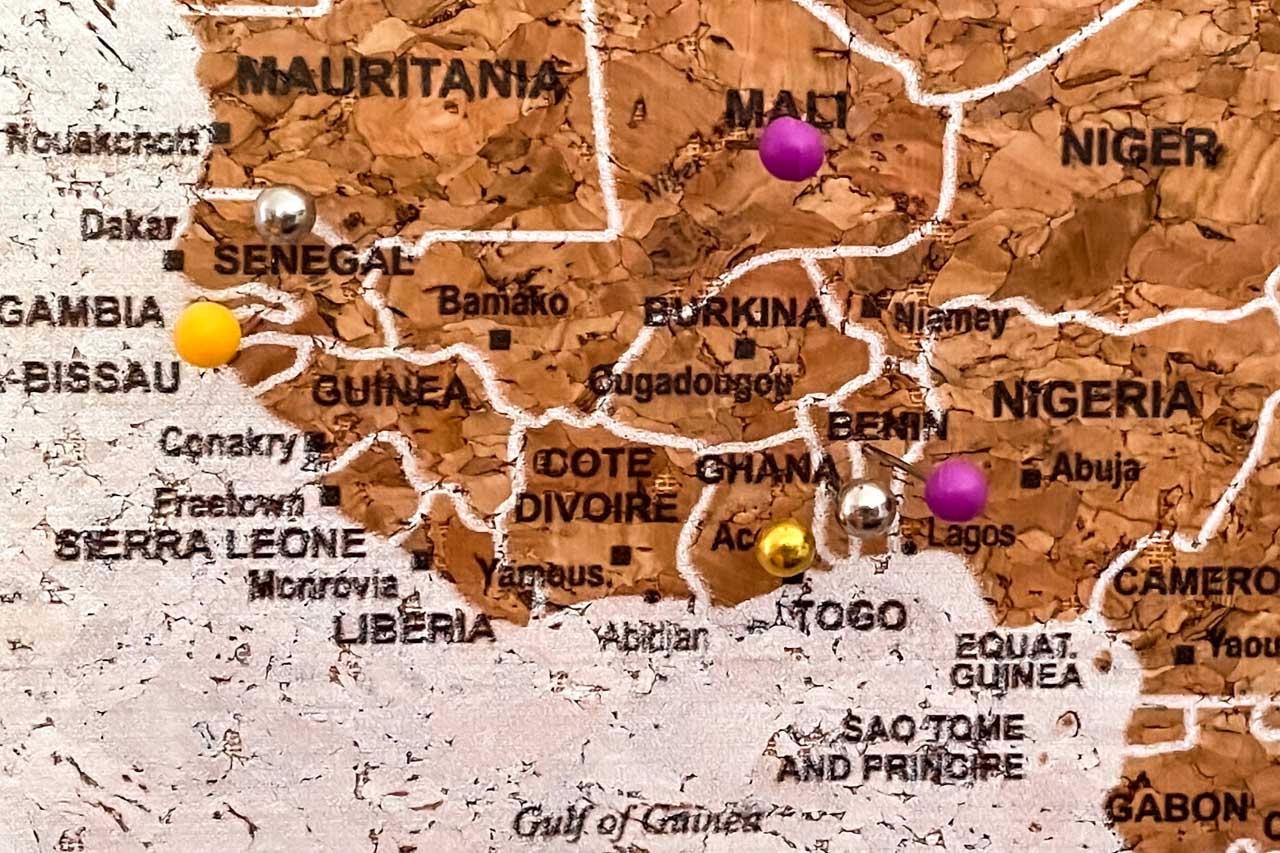
Benin (officially the Republic of Benin) is a sliver of a nation in West Africa on the Atlantic Ocean. It borders Togo to the west, Nigeria to the east, and Burkina Faso and Niger to the north. Ouidah is a city on Benin’s narrow strip of coastline and was the ancient port of the slave trade.

An image of a map of West Africa

Map of West Africa


Attending Benin’s Voodoo Festival in Ouidah was my primary reason for travelling to West Africa.

Voodoo is one of Benin’s official religions, while Ouidah is considered the birthplace of Voodoo. It is probably one of the most misunderstood religions in the world. West African Voodoo is a complex religion rooted in healing and doing good to others. It is not the stuff of Hollywood – of witchcraft and black magic or sticking pins in dolls.

I must admit it was curiosity that fed my travel plans to include the Voodoo Festival in Ouidah. I wanted to witness this annual celebration of Benin’s heritage and traditional culture and to experience a unique festival.

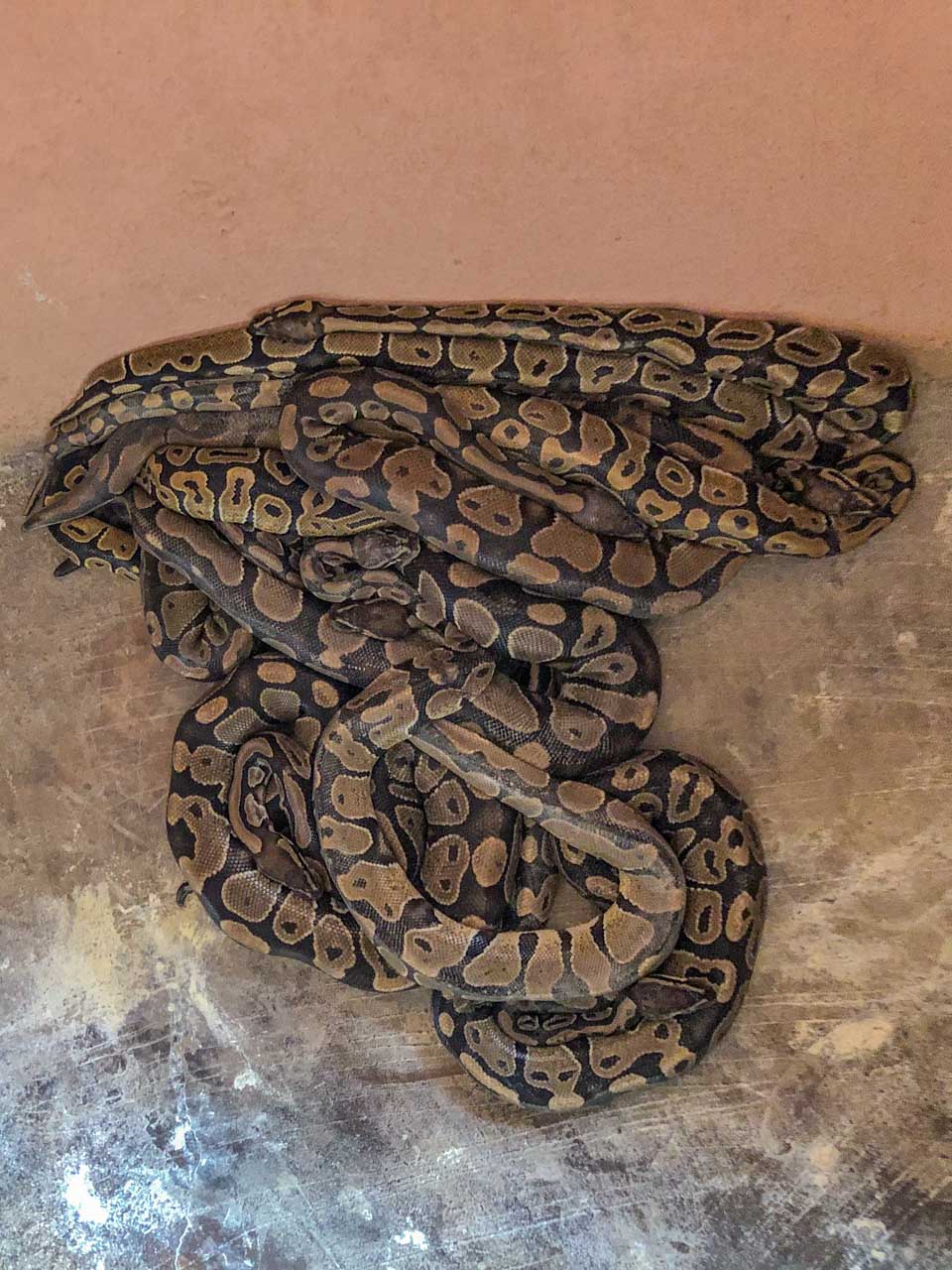
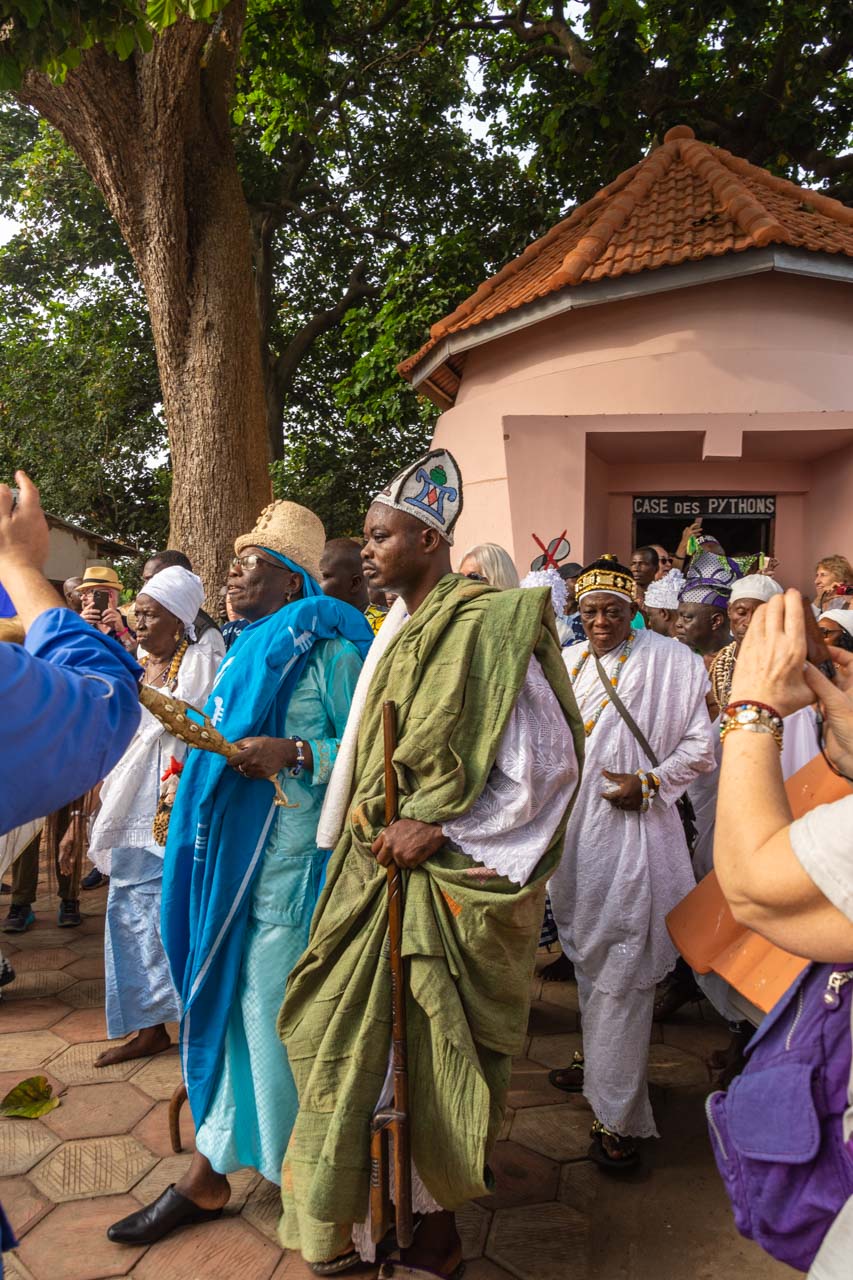
My participation at the Voodoo Festival commenced with a visit to Ouidah’s Temple of Pythons – one of Voodoo’s most revered places and home to some 60 pythons. The pythons are a significant symbol for followers of Voodoo. They are not feared but are revered and worshipped. These pythons were said to be docile, which was just as well because they roamed freely. It was here, through a break in the trampling crowd, that I momentarily sighted the Voodoo Pope who had come to pay homage at the Temple of Pythons.

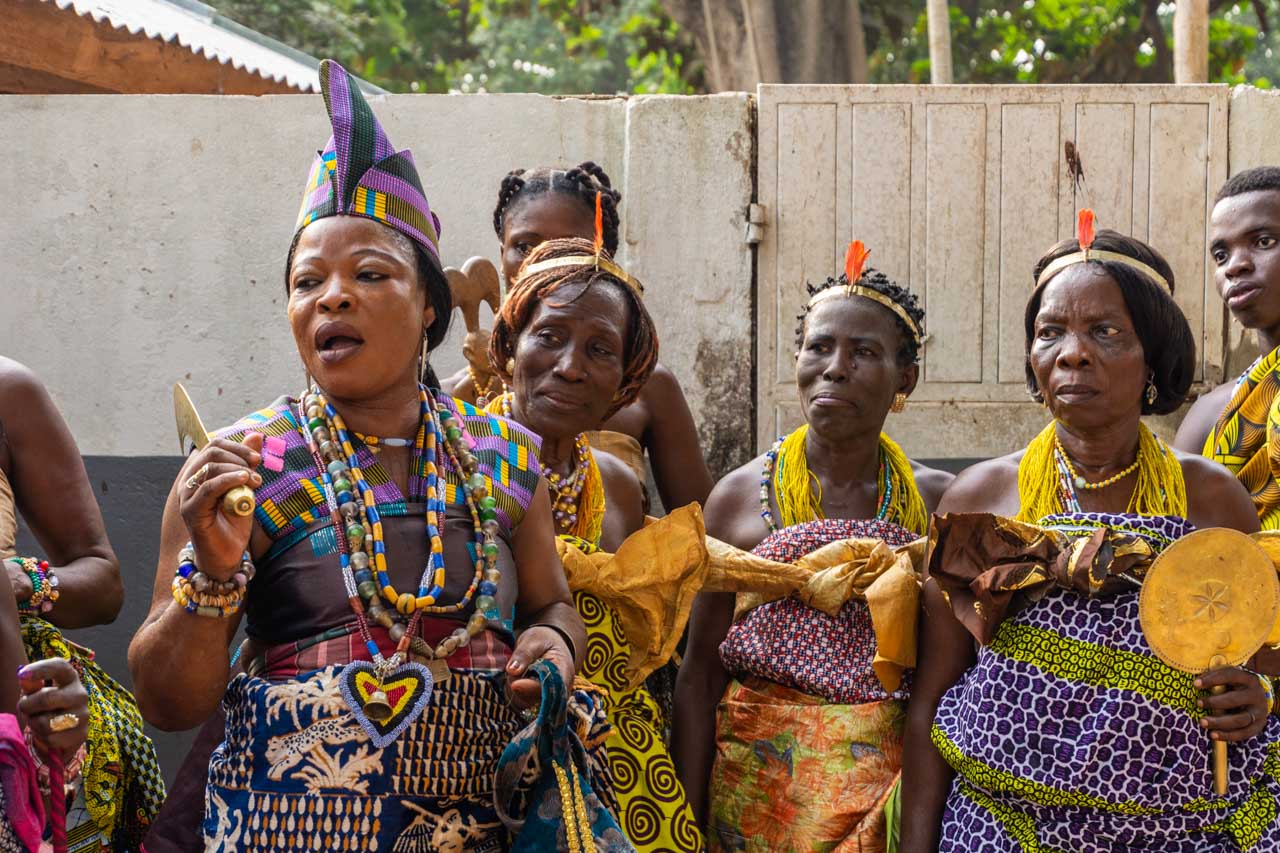
a group of women dressed in multi-coloured clothing and each wearing many bead necklaces.

Female Voodoo devotees at the Temple of Pythons


From the Temple of Pythons, the Voodoo Pope led a procession along the historical, 3-kilometre Slave Road to the ‘Door of No Return’ (of slave trade infamy) on Ouidah’s beach on the Atlantic coast. It was on this stretch of sand that the celebrations of the Voodoo Festival truly got underway.

And what a celebration!

With the dignitaries’ speeches over (this took over an hour), it was party time. But first, the spirits and Voodoo gods needed to be appeased with the sacrifice of a goat. The Voodoo Pope carried out this ritual behind a circular wall of blue plastic away from public view. Animal sacrifice is a fundamental element in Voodoo. No Voodoo ceremony is worth its salt without an animal sacrifice in exchange for favours from the spirits.

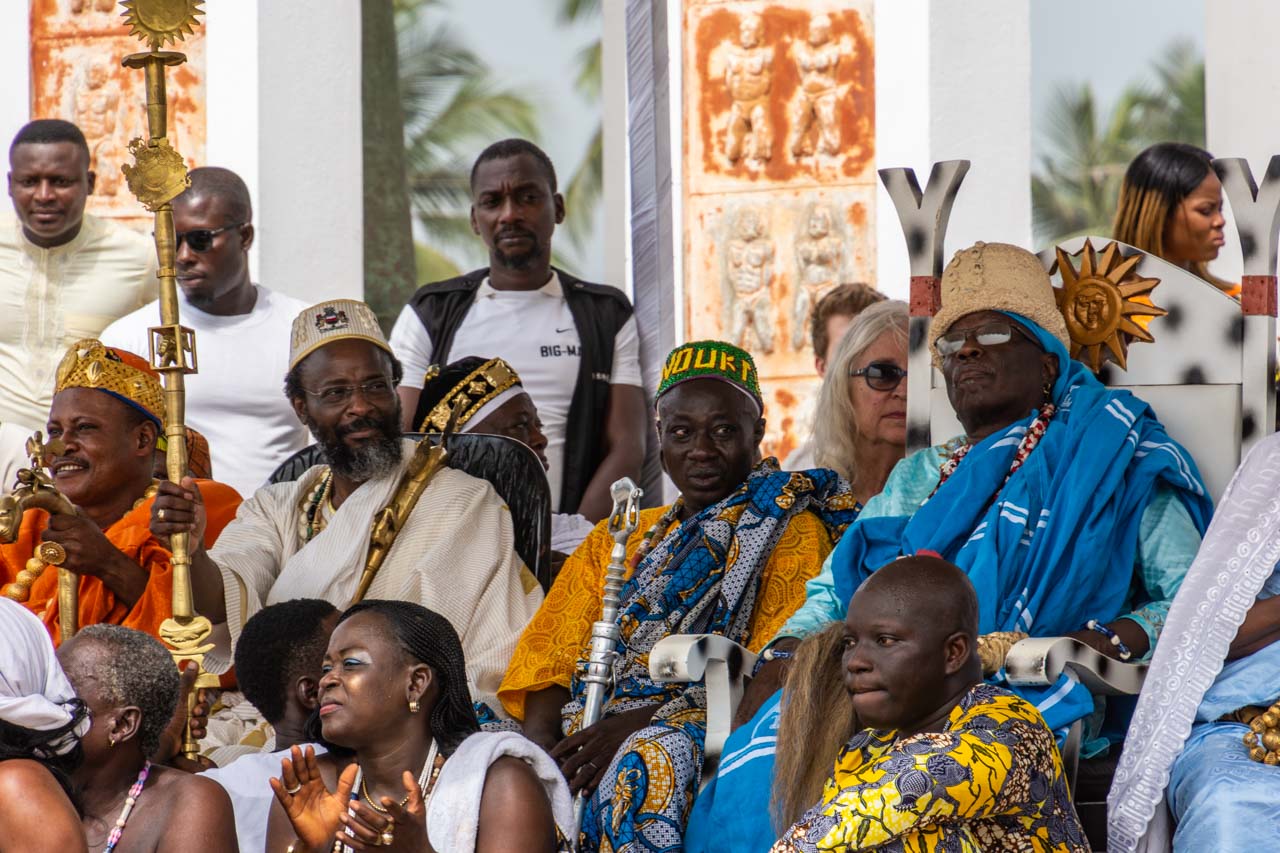
Immediately following the sacrifice, the Voodoo Pope made his way to his throne in the shadow of the Door of No Return. I say ‘throne’ because the festival hosts referred to him as “His Majesty the Pope”.

A seated group of men and women dressed in multi-coloured clothing.

The Voodoo Pope (in blue robes) on his throne


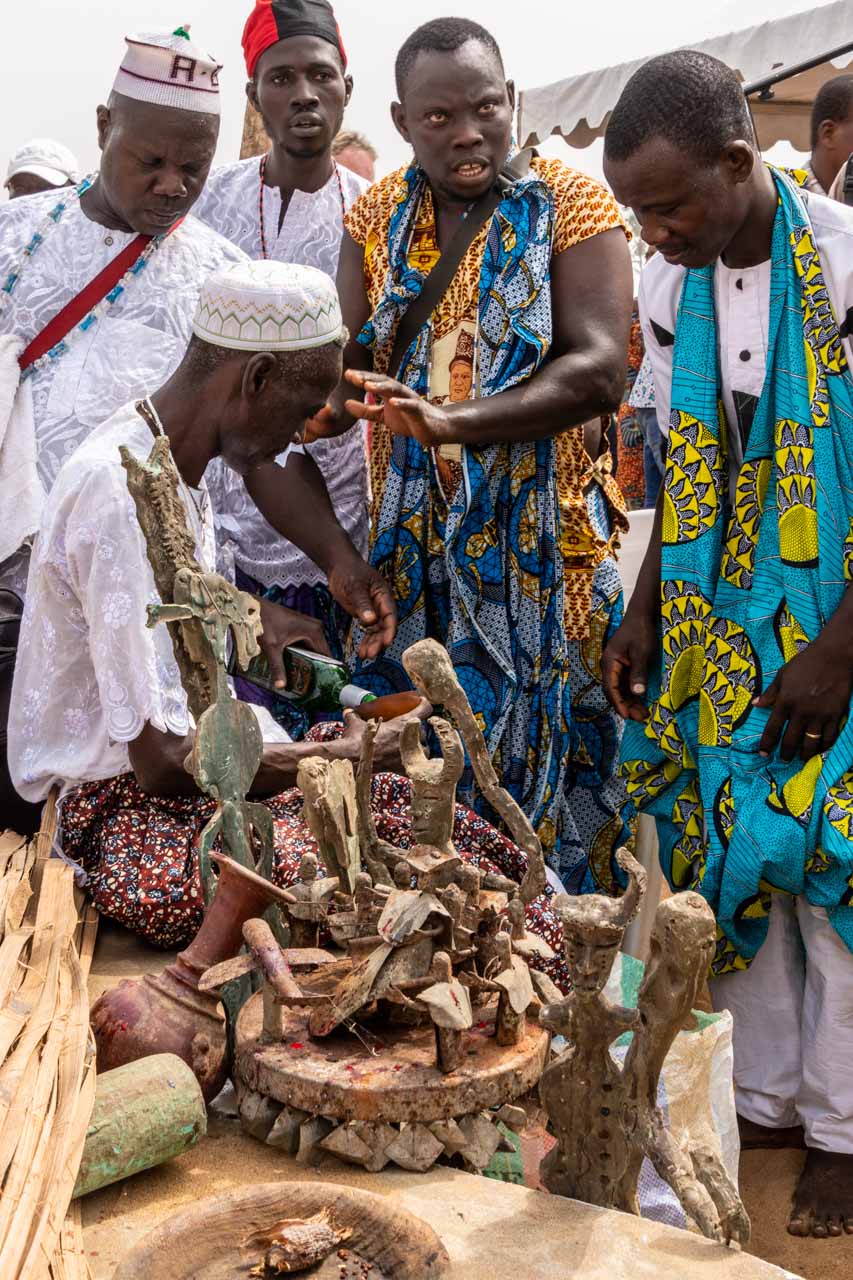
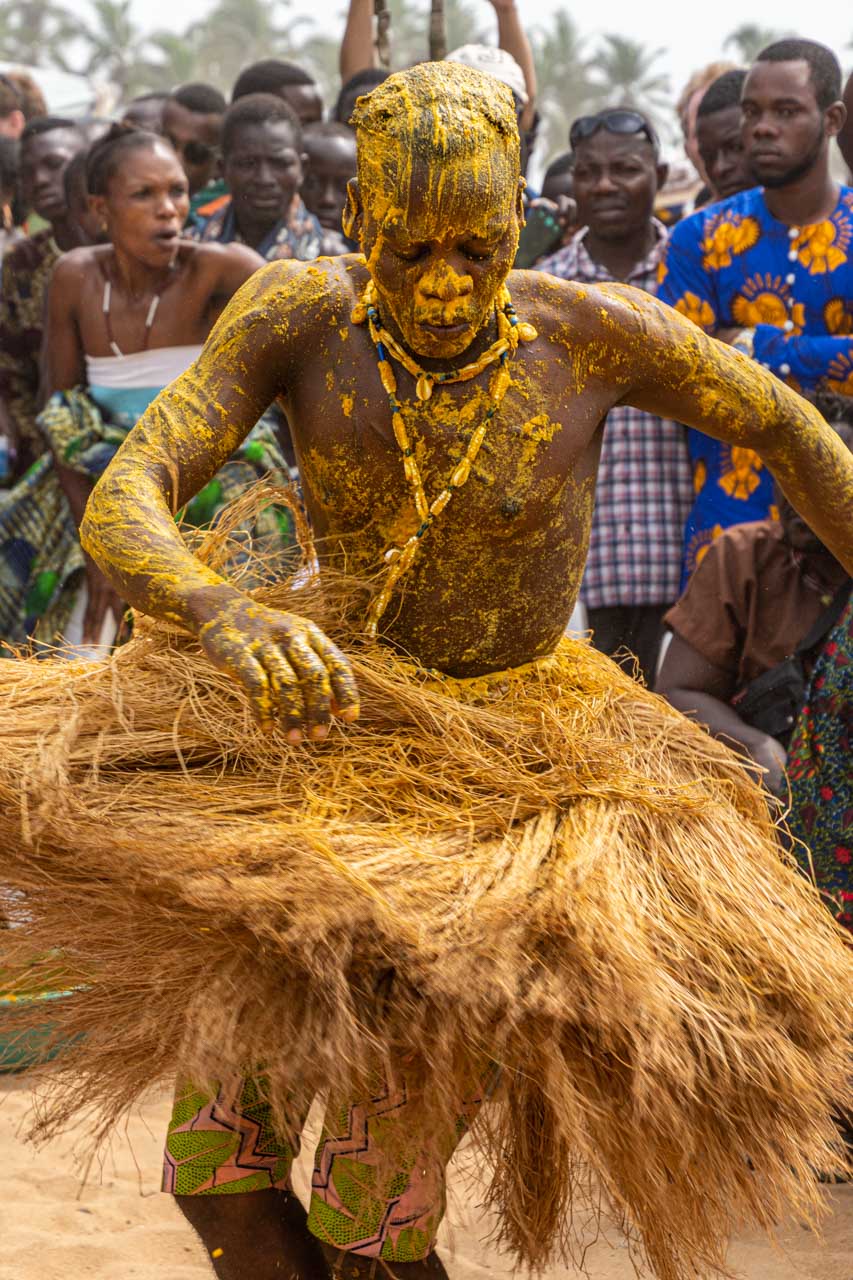
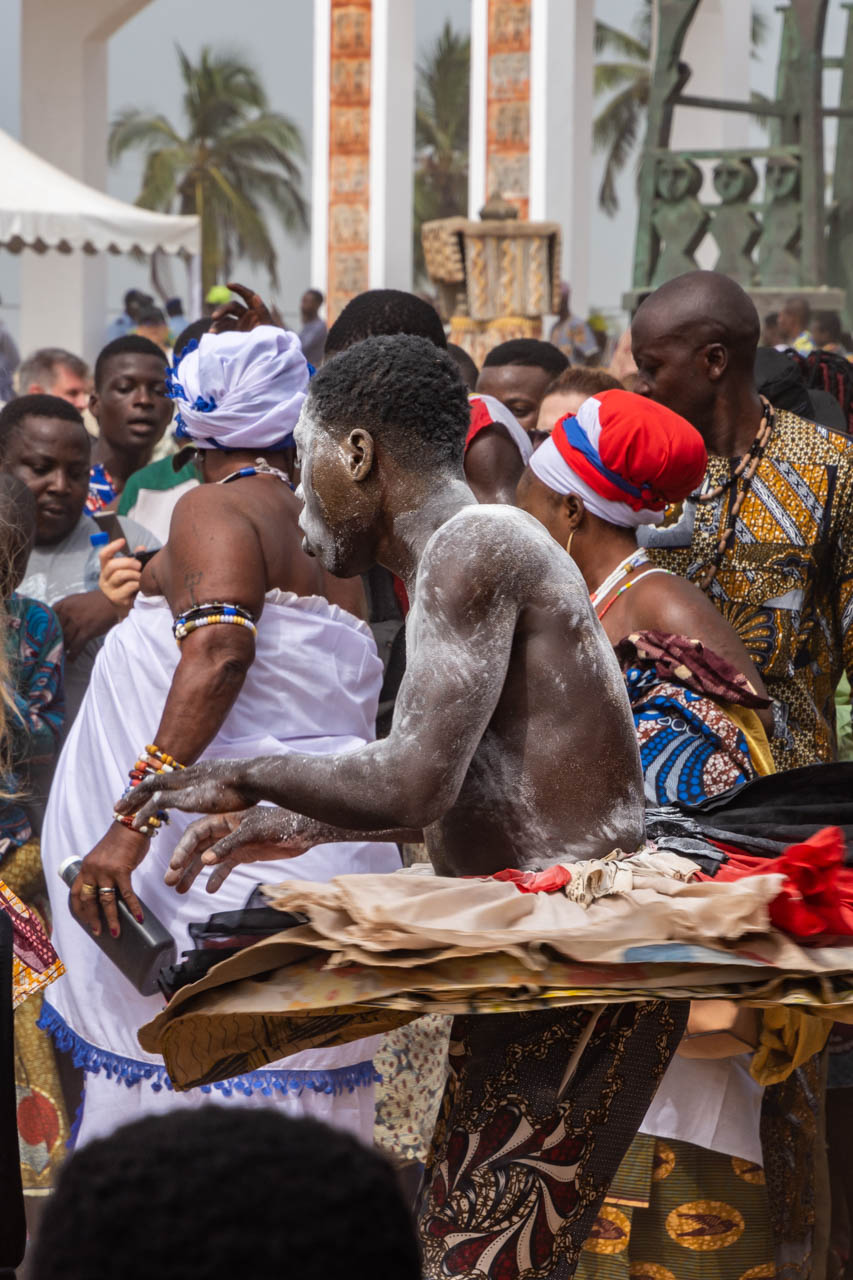
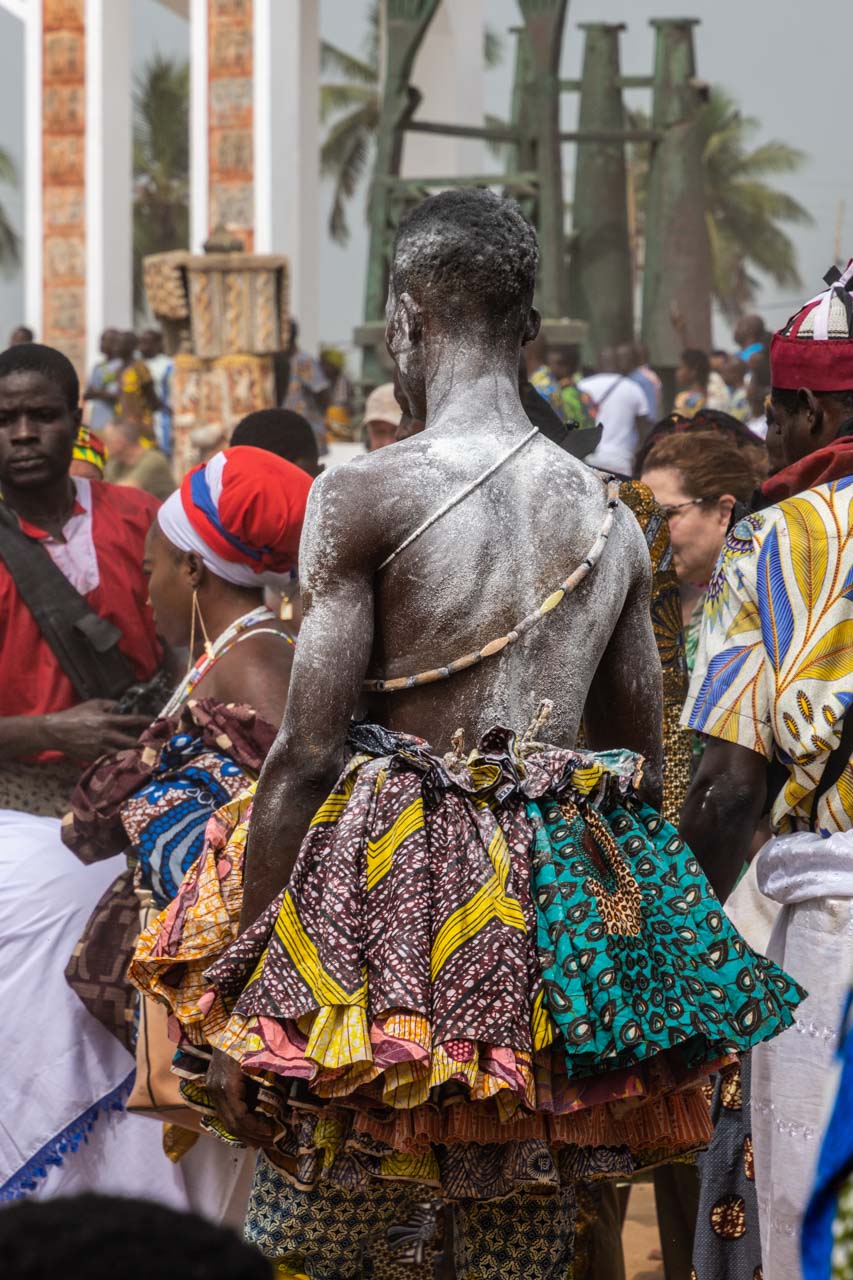
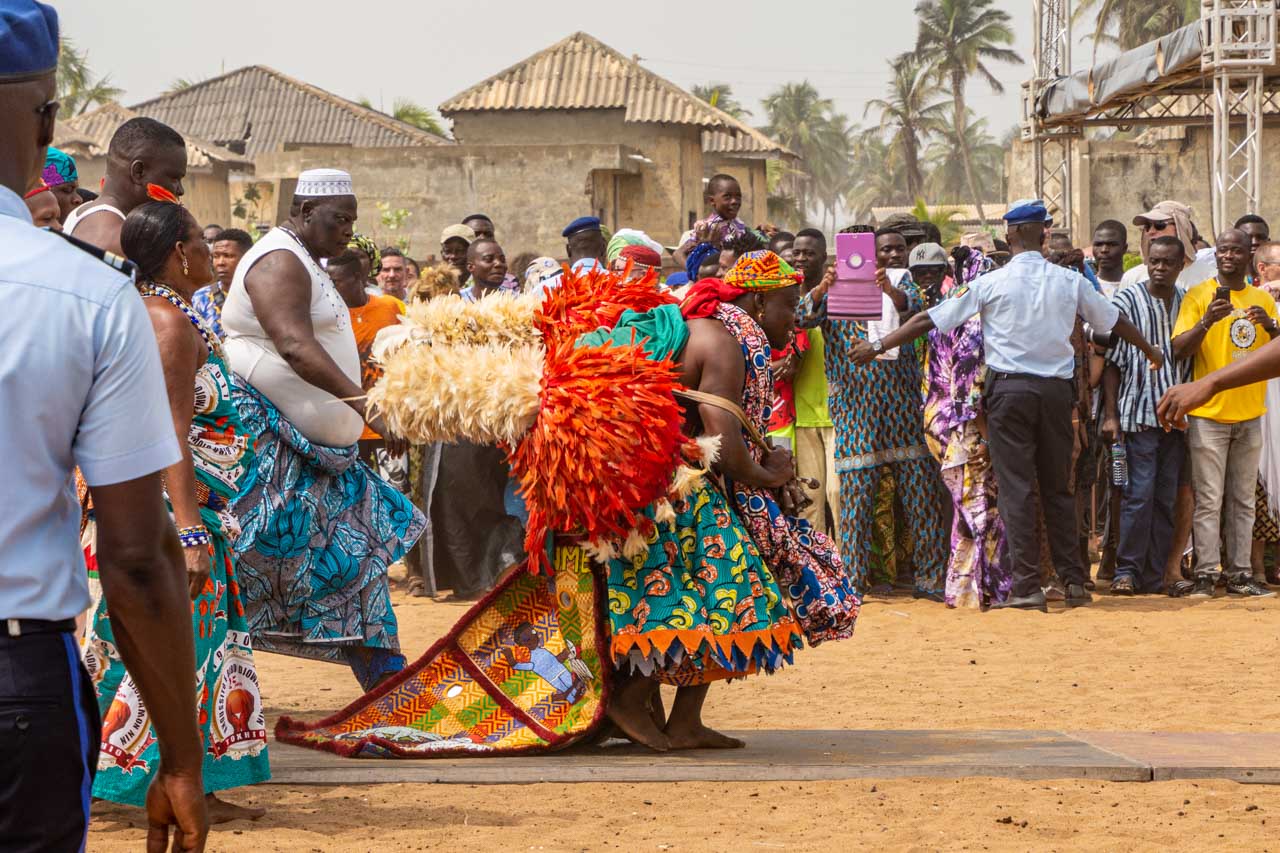
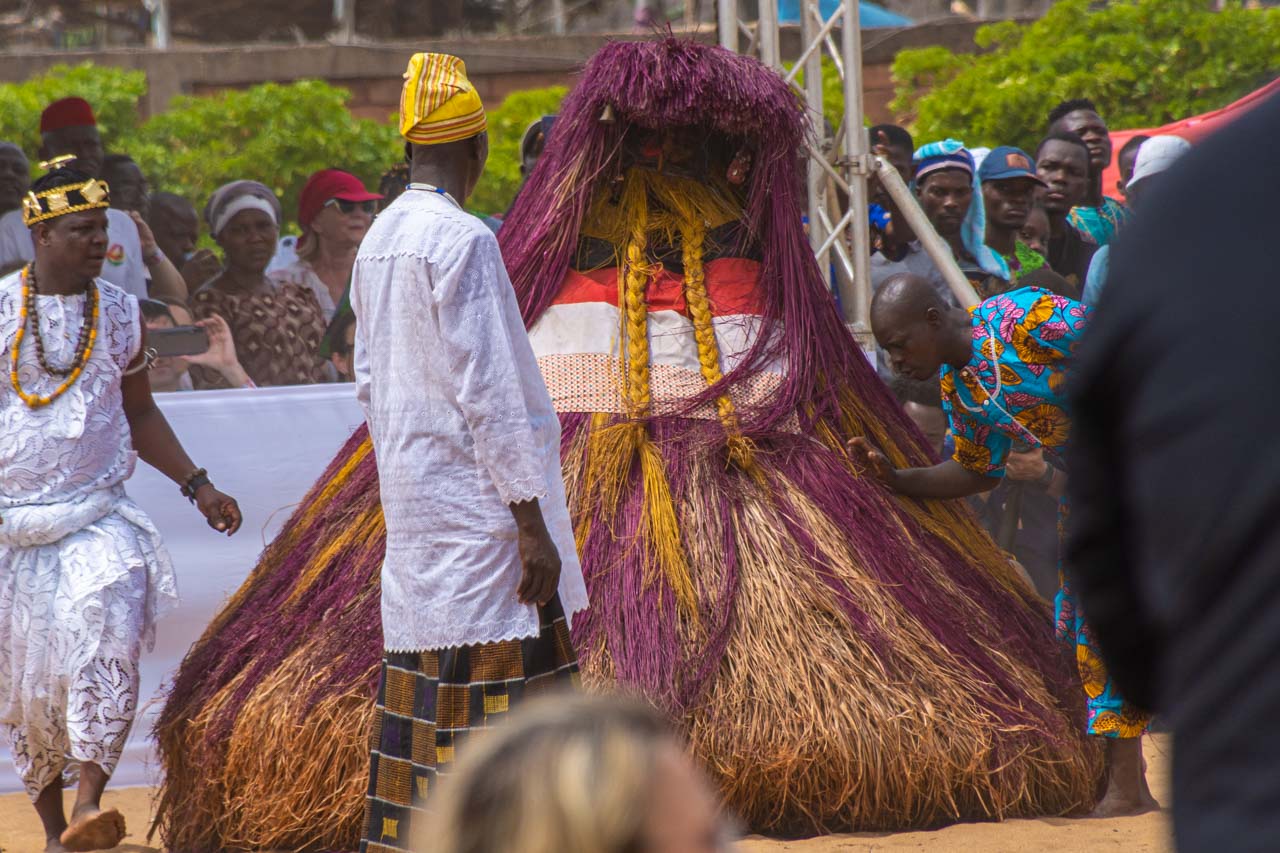
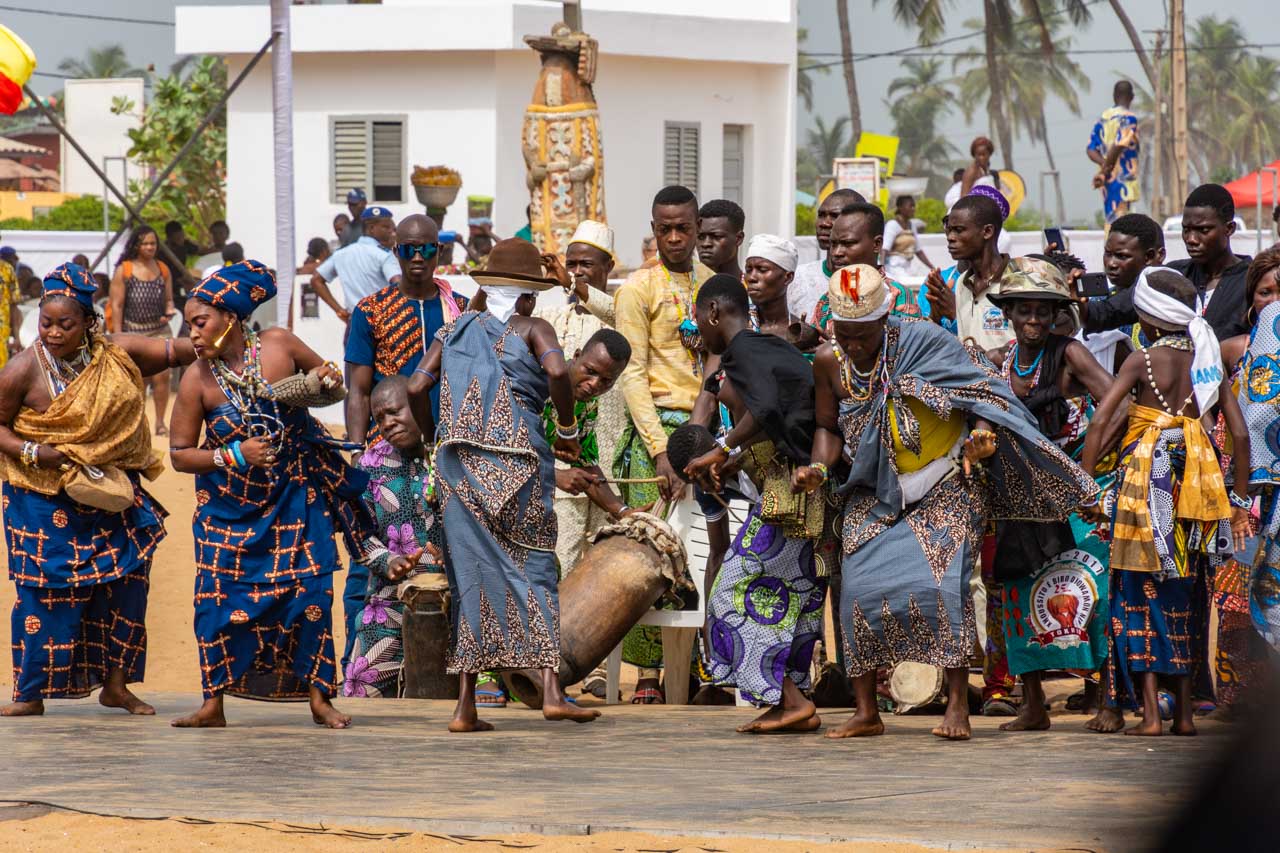
With the Voodoo Pope seated, the atmosphere changed. The speeches gave way to vibrant displays of dancing and the throbbing of drums. I witnessed ‘exorcisms’ in which a seemingly possessed person would run away from a group of people, only to be caught, dragged to the ground, and sprinkled with powder. The crowd became particularly excited when coloured haystacks appeared, spinning around the grounds. I learned these ‘haystacks’ are Voodoo spirits known as Zangbeto and are the traditional Voodoo guardians of the night – the Nightwatchmen. They are the unofficial police force and dispensers of justice. I did not envy the human police who battled to keep the crowds from encroaching on dancers and Voodoo spirits.

With so much going on around me, I wandered around aimlessly. I didn’t know which group to stay and watch or where to go next. But I was intent on seeing it all. I moved around the festival for a couple of hours until I decided it was time to sit down and people watch.

Overall, the celebration at the Voodoo Festival in Ouidah was a hive of activity in which people would swarm from one dance display to another. A kaleidoscope of colour from the attire worn by attendees and a cacophony of noise from the frantic pounding of drums dominated the festival. The crowd was buzzing.

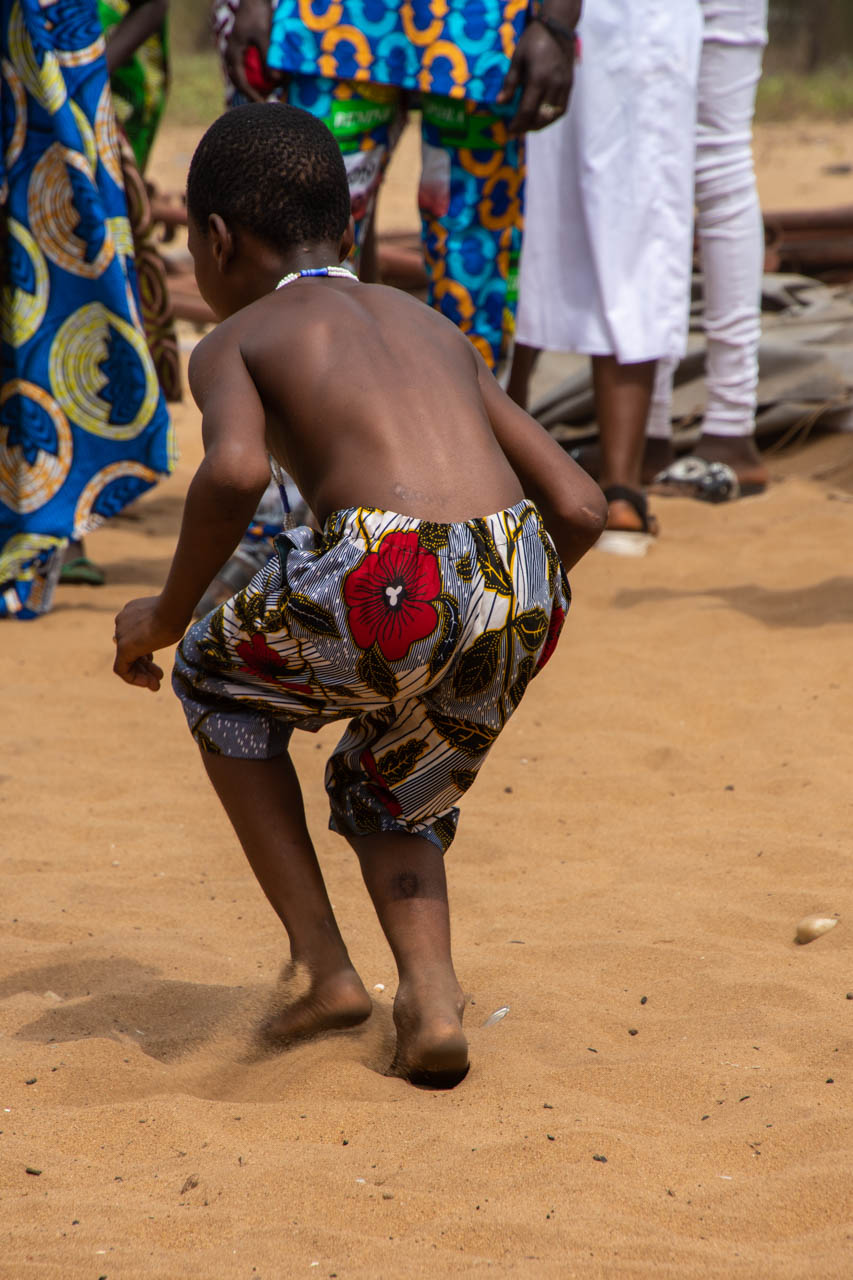
But perhaps, the best way to describe the Voodoo Festival and my experience is to share some of my photos with you.


Ouidah’s Voodoo Festival was a never to be forgotten experience.


Disclaimer: This post contains no affiliate links. All views and opinions are my own and non-sponsored. All photos are my own and remain the copyright © of Just Me Travel 2021.


Which festival have you attended that has been a ‘never to be forgotten experience’ for you? Tell us about it. Please leave a comment below to share your thoughts.


Like this post? PIN it for later!


Related posts

For more posts on Africa, visit Just Me Travel: https://justme.travel/category/destinations/africa/


Author’s Note: Please check the latest travel restrictions before planning any trip, and always follow government advice.


No Comments on OUIDAH VOODOO FESTIVAL IN BENIN – a joyous celebration with 13 photos to inspire [2021 UPDATED]

Type on the field below and hit Enter/Return to search